Sun, 13 Sep 2026

td 0.0.7 on CRAN: New Features and Updates

A new version 0.0.7 of the td package for accessing the twelvedata API for financial is now on CRAN, and has been built for r2u.

This release combines the standard set of maintenance changes that accrue in a four and a half year period (!!) as that much time has past since the previous release. But it also contains two contributed functions to retried, respectively, a profile (available under a paid plan) and a set of main fundamental data statistics, both provided Kenneth Rose.

The NEWS entry follows.

Changes in version 0.0.7 (2026-09-13)

  • Added fun_statistics and fun_profile function

  • Expanded README.md with additional badges, and updated URLs

  • Updated continuous integration multiple times

  • Switched to Authors@R

Thanks to CRANberries, you can also look at the most recent diff to the previous release. See the project page, the github repo, and the package documentation for more details.

This post by Dirk Eddelbuettel originated on his Thinking inside the box blog. If you like this or other open-source work I do, you can now sponsor me at GitHub.

/code/td | permanent link

Sat, 12 Sep 2026

sanitizers 0.1.2 on CRAN: Maintenance

bleach

The third release (in twelve years !!) of the sanitizers package is now on CRAN. sanitizers provides ‘true positives’ for programming errors detected by the Address Sanitizer and friends such as the Undefined Behavior Sanitizer. This permits validation of the setup when chasing such bug reports: it allows us to ascertain that the compiler (and instrumented R version) are correctly set up and the errors we expect to be reported are in fact reported. That established, a proposed fix no longer exhibiting that same error will then likely be a suitable one.

A very good resources for all things sanitizers is the Google repo at GitHub and especially its wiki.

A little over twelve years since the first release, and three years since the second one, this update brings chiefly internal package changes and maintenance. No functional changes, no behavioural changes.

The brief NEWS entry follows.

Changes in version 0.1.2 (2026-09-12)

  • Expanded README.md with additional badges, and updated URLs

  • Updated continuous integration multiple times

  • Switched to Authors@R

  • Added usage, arguments and value sections to manual page

Thanks to CRANberries, you can also look at the most recent diff to the previous release. See the project page, the github repo, and the package documentation for more details.

This post by Dirk Eddelbuettel originated on his Thinking inside the box blog. If you like this or other open-source work I do, you can now sponsor me at GitHub.

/code/sanitizers | permanent link

Thu, 10 Sep 2026

RDieHarder 0.2.8 on CRAN: Minor Maintenance

An new maintenance version 0.2.8 of the random-number generator tester RDieHarder (based on the DieHarder suite developed / maintained by Robert Brown with contributions by David Bauer and myself along with other contributors) is now on CRAN and available via r2u.

This release contains only internal maintenance changes: continuous integration was updated a few times, newer nags from R are addressed in Rd files and the vignette, and we also updated a few URLs in the vignette and README.me. No new code, no new features.

Thanks to CRANberries, you can also look at the most recent diff to the previous release.

This post by Dirk Eddelbuettel originated on his Thinking inside the box blog. If you like this or other open-source work I do, you can now sponsor me at GitHub.

/code/rdieharder | permanent link

Wed, 09 Sep 2026

RcppXts 0.0.7 on CRAN: Minor Maintenance

A new maintenance release 0.0.7 of RcppXts is now on CRAN, and has been built for r2u. The RcppXts package demonstrates how to access the export C API of xts which we contributed a looong time ago. There are by now a more example packages around this C level access to another package, but this one was an early example.

This release is strictly maintenance, updating continuous integration, the README.md file and other packaging conventions adopted since the last release four years ago.

The NEWS entries follow.

Changes in version 0.0.7 (2026-09-09)

  • Corrected a docstring for the module

  • Updated continuous integration setup several times

  • Simplified setup by removing no-longer-needed Makevars

  • Added badges to README.md

Courtesy of my CRANberries, there is also a diffstat report for this release. For questions, suggestions, or issues please use the issue tracker at the GitHub repo.

This post by Dirk Eddelbuettel originated on his Thinking inside the box blog. If you like this or other open-source work I do, you can now sponsor me at GitHub.

/code/rcpp | permanent link

Tue, 08 Sep 2026

RcppArmadillo 15.6.0-1 on CRAN: New Upstream Minor

armadillo image

Armadillo is a powerful and expressive C++ template library for linear algebra and scientific computing. It aims towards a good balance between speed and ease of use, has a syntax deliberately close to Matlab, and is useful for algorithm development directly in C++, or quick conversion of research code into production environments. RcppArmadillo integrates this library with the R environment and language–and is widely used by (currently) 1331 other packages on CRAN, downloaded 48.5 million times (per the partial logs from the cloud mirrors of CRAN), and the CSDA paper (preprint / vignette) by Conrad and myself has been cited 727 times according to Google Scholar.

This versions updates to the 15.6.0 upstream Armadillo release made yesterday. It extends solver options for poorly conditioned systems, and brings some updates and extension to the cube data type. For this release, we once again ran the usual complete reverse-dependency check which came back spotless, and did CRAN so no email exchange needed despite nearly 1300 reverse dependencies (but it ended up taking more than a single business day). Still, automation can be helpful when used with a well-maintained software stack. The package has also already been updated for Debian, built for r2u and r-universe, and will build shortly at CRAN for the different binary releases.

All changes since the last CRAN release follow.

Changes in RcppArmadillo version 15.6.0-1 (2026-09-07)

  • Upgraded to Armadillo release 15.6.0 (Medium Roast Cortado)

    • Expanded solve() with solve_opts::scale_thresh option to widen detection of poorly conditioned systems

    • Expanded trans() and .t() to handle cubes

    • Added permute() to rearrange dimensions of cubes (generalised transpose)

    • Added cubemul() for batched matrix multiplication of cube slices

Courtesy of my CRANberries, there is a diffstat report relative to previous release. More detailed information is on the RcppArmadillo page. Questions, comments etc should go to the rcpp-devel mailing list off the Rcpp R-Forge page.

This post by Dirk Eddelbuettel originated on his Thinking inside the box blog. If you like this or other open-source work I do, you can sponsor me at GitHub.

/code/rcpp | permanent link

Sun, 06 Sep 2026

RcppFarmHash 0.0.4 on CRAN: Maintenance

Another minor maintenance release of the RcppFarmHash package is now on CRAN as version 0.0.4.

RcppFarmHash wraps the Google FarmHash family of hash functions (written by Geoff Pike and contributors) that are used for example by Google BigQuery for the FARM_FINGERPRINT digest.

This releases updates several of package internal files for continuous intergration and package data.

The brief NEWS entry follows:

Changes in version 0.0.4 (2026-09-06)

  • Minor updates to continuous integration, README.md and DESCRIPTION

Courtesy of my CRANberries, there is also a diffstat report for this release. For questions, suggestions, or issues please use the issue tracker at the GitHub repo.

This post by Dirk Eddelbuettel originated on his Thinking inside the box blog. If you like this or other open-source work I do, you can now sponsor me at GitHub.

/code/rcpp | permanent link

Sat, 05 Sep 2026

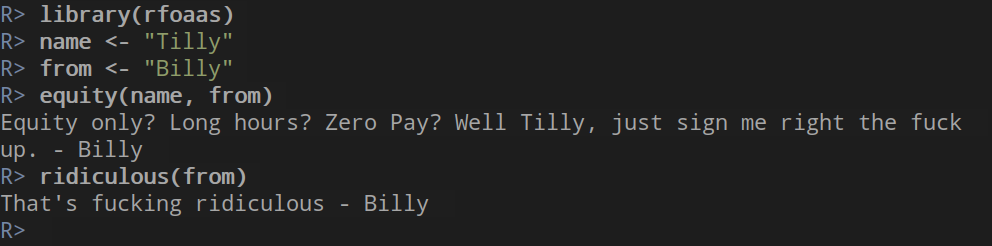
rfoaas 2.4.0 at CRAN: Fully Restored Functionality

rfoaas greed example

FOASS is back at a new site / url since late August! It restores original FOAAS functionality and full set of REST access points including the language filters.

So this new rfoaas release restores all accessor functions re-enabling full R access, documents, and tests them. We re-enabled code coverage too. This corresponds to the upstream version 2.4.0 in the forked FOASS repo, and by our convention we use the same version number for the R package.

My CRANberries service provides a comparison to the previous release. Questions, comments etc should go to the GitHub issue tracker. More background information is on the project page as well as on the github repo

This post by Dirk Eddelbuettel originated on his Thinking inside the box blog. If you like this or other open-source work I do, you can sponsor me at GitHub.

/code/rfoaas | permanent link

Fri, 04 Sep 2026

#059: r2u, GitHub Actions, a Tragedy of the Commons, and a Fix

Welcome to post 59 in the R4 series.

How did we get here: A initial words about GitHub. GitHub Actions provides (essentially unlimited) compute time. This further boosts a service already in a market-dominating position: GitHub1 as a code repository. Those of us old enough to remember the start of git (the program and protocol) may remember the extremely bare-bones initial hosting site repo.or.cz (launched in 2006). GitHub came two years later, and put an enormous amount of focus into design and user interfaces. To cut a long story short, GitHub won the services war. And with it git won the platform war. To a first approximation, everybody and everything is on GitHub.2 So the repository is already dominant.3 And then free compute was added.

So given its scale and positioning, and its essentially free provisioning of free multi-core compute setups with generally decent connectivity, widespread adoption happened. And as is goes, some mischief is bound to happen. And it did. More on that below.

A few words about r2u: r2u makes all packages on CRAN, i.e. the code repository network for R, install fast, reliably and easy on Ubuntu by making them available to apt, the native package manager. It is to our knowledge also the first and only time an entire open source programming repository is available in binary form with all dependencies resolved. It is going strongly: the last monthly use topped five million packages. See the r2u website for more.

r2u and GitHub: For the first few years, builds for r2u were done locally on my machine, and then uploaded to the primary repositry r2u.stat.illinois.edu. I do not recall systemic outages or connection issues though occassional network timeouts were seen. Once we started to support arm64 (in addition to the default amd64) binaries, building those switched to GitHub Actions simply because … they had runners for arm64 while I had no arm64 hardware. The experience of building packages (in bulk) was rather positive. So we investigated builds for amd64 too. If memory serves we first did this for either one of the semi-annual BioConductor updates. Before long, builds for amd64 followed meaning all of r2u was being built in GitHub Actions.

During these builds, I would regularly encounter builds failures: “cannot connect to r2u.stat.illinois.edu”. I misdiagnosed this as a resource issue on the GitHub side, and consequently made (several) attempts at robustifying the builds via for example longer (download) timeout limits as well as checks for build failures and conditional rebuilds. Needless to say, and given what we know now (more on that below), this did not work. But it went on for a few months this spring and summer. What did work was to simply relaunch under ‘re-run failed jobs’. Given the distributed nature of GitHub Action this generally allocates to a different machine and address and succeeds. In the grand scheme of things a nuisance as we a need second run, but given the fourty (!!) concurrent jobs this tends to be quick. So a minor nuisance.

This discribed the production side. On the consumption side, one prominent user of r2u, especially at GitHub, is our r-ci setup for continuous integration. It too could fail at times, and a simple re-run would fix it. Annoying, if addressable manually. Usage by others I cannot monitor so I can only assume that the random failure nature must have frustrated them too. Potentially a much bigger nuisance.

As users were getting annoyed, some took action. Jeffrey Girard opened discussion topic #159 which contained a thorough investigation of his confirming that only amd64 nodes were affected. This had not been noticed before. Troy Hernandez set up a full harness with tests in an ad-hoc repo designed for repeated remote triggering. This also logged the IP addresses for success or failure. Through both these approaches it became (eventually) clear that the failures were limited to either certain (individual) IP addresses, or IP subnets.

When taking the conversation back to network service at U of Illinois, we realized that the issue was in fact caused by a network policy at the university. And specific to GitHub.

In fact, what happened initially were waves of port scanning attacks originating from GitHub IP addresses. As (essentially) “anybody” can run code there, bad actors can too. The response from the university side was reasonable and swift: Identified IP addresses were added to a ‘null-router’ that (essentially) swallows traffic. And that was the cause of the perceived-as-random outages: Jobs that ended up failing at GitHub Actions were the ones assigned to addresses that have previously been seen as port scanning.

Shifting production: Once this was confirmed, I investiaged alternatives. On the production side using different machines would help. So I tried blacksmith.sh, a competing alternate service offering faster runners as ‘drop-in replacements’ for the GitHub Actions runners. This worked great, until I ran up against my ‘free cpu minutes quota’. In a mere two days (that were arguably overly busy as it was shortly after CRAN reopened after the summer break). Given that the service would not sponsor us a supported open source software project with sufficient quota, we moved off blacksmith.sh after two days.

A first programmatic response: consumption-side: For the r-ci client side, it was straightforward to setup a check and subsequent workaround. When curl fails with a silent HEAD attempt at the primary repository failed, we take this to be caused by presence of a null-router entry for the IP we are on, and switch the apt setup to the secondary repository. Which may be slower, or at rare times unreachable itself – but still provides a fine fallback when a node is ‘prohibited’ from talking to U of Illinois resources such as r2u.stat.illinois.edu. Having used this for a few days in r-ci it seems to work.

A second programmatic response: production-side: For the r2u builds, and given that blacksmith.sh would not grant ‘most-favored status’ with sufficient free minutes, we switched our Docker-based setup to switch to the secondary when an initial probe fails. That was added last weekend, and appears to work just swimmingly. Another application to the fundamental theorem of software engineering: another layer of indirection can solve just about any problem.

For completeness, the corresponding code is

webstatus=$(curl --head --silent --no-fail --output /dev/null \
                 --write-out "%{http_code}" https://r2u.stat.illinois.edu || true)
if test "${webstatus}" = "200"; then
    echo "The r2u repository is reachable."
else
    extip=$(curl --silent https://ipinfo.io/ip)
    echo "::notice::The primary r2u repository is **not reachable** from ${extip}."
fi

We run an initial curl test (without failing) and have it report the HTTP return code. 200 means no issue, all others are suspect here—so we run a second curl query to obtain our external IP and log it. We use the same logic in another spot from inside the build container and use the else branch to switch apt to the secondary repository via sed call on the .sources file.

Logging of ‘bad’ IPs: On both our sides, i.e. production as well as consumption, we now also log the IP addresses of the failing nodes and will ask network security to remove these from the null router. If our jobs can be assigned to them it clearly shows the machines are part of the normal compute pool and are not doing anything nefarious at the moment. So they should be removed from the null-router list. We will see how that fares.

Putting it all together: Providing a free resources can, sadly, lead to an a decline the service experience just as the tragedy of the commons analysis would predict. Restricting, or ‘pricing’ use may be a stock answer but I for one am glad GitHub Actions is still free. But we need to do our bit of upkeep. Just as network security logs bad actors (taking advantage of the free resource) we should make an effort to unlist nodes no longer part of any portscan (or alike) swarm.

For r-ci users, there is hopefully little to do (if you rely on the standard action). We do now catch a node that was assigned a continuous integration job cannot connect to r2u as we can test this easily (and cheaply). Pivoting to the secondary repository is a valid, and working, answer. Hopefully over time we can also work towards restricting the null-router list down to recent entries and fewer overall, thereby lowering the chance of gitting a bad IP. Eventually, we could also overly a CDN proxy to avoid the ‘bad IP’ problem. It is something to consider.

Summing up: We are still chuffed at how successful r2u has become, and how much can be done with GitHub Actions. Sadly, as we found out, there can also be a ‘tax’ on letting compute happen there but as discussed in this note, there are ways to avoid it by pivoting to alternate repository source.

This post by Dirk Eddelbuettel originated on his Thinking inside the box blog. If you like this or other open-source work I do, you can now sponsor me at GitHub.


  1. Before we really get started, one clarification. GitHub and its services including GitHub Actions have been in the news lately as they suffered a number of high-profile outages. While also arguably a tragedy of the commons problem, it is not what this note is about. If you prefer to be enraged about GitHub services, or the (relevant) lack thereof, this may not be for you.↩︎

  2. The year is 2026 and politics is what it is, of course non-US alternatives emerged and will remain available and used. But dislodging established first-mover advantages will most likely take more than a (at least for now still-small) number of users unhappy for various (and sensible) reasons. We will see how this pans out.↩︎

  3. Entire essays (or book) can be / will be / have been written about the competitive situation, how GitLab did not make enough of a dent, how Gitea remained niche and of course now Codeberg. This is not that essay, and I do not have a strong view but let me mumble a quiet plus ça change, plus ça reste la même chose↩︎

/code/r4 | permanent link

Thu, 03 Sep 2026

RcppExamples 0.1.11 on CRAN: Very Minor Maintenance

A new version 0.1.11 of the RcppExamples package is now on CRAN, and has been built for r2u.

RcppExamples provides a handful of short examples detailing by concrete working examples how to set up basic R data structures in C++. It also provides a simple example for packaging with Rcpp. The package provides (generally fairly) simple examples, more interesting, compelling (and generally longer) examples are at the Rcpp Gallery.

This releases updates a few Rd files to adhere to a stricter standing of checking by R. The NEWS extract follows:

Changes in RcppExamples version 0.1.11 (2026-09-03)

  • Add now-checked-for missing sections to manual pages

  • Updated continuous integrations two more times

Courtesy of my CRANberries, there is also a diffstat report for this release. For questions, suggestions, or issues please use the issue tracker at the GitHub repo.

This post by Dirk Eddelbuettel originated on his Thinking inside the box blog. If you like this or other open-source work I do, you can now sponsor me at GitHub.

/code/rcpp | permanent link

Wed, 02 Sep 2026

RcppClassicExamples 0.1.5 on CRAN: Very Minor Maintenance

Another minor maintenance release version 0.1.5 of package RcppClassicExamples arrived earlier today on CRAN, and has been built for r2u. This package illustrates usage of the very old and otherwise deprecated initial Rcpp API which no new projects should use as the normal and current Rcpp API is so much better.

This release follows one from six months ago, and is even smaller. We just update a few Rd files to adhere to a stricter standing of checking by R.

No new code or features. Full details below. And as a reminder, don’t use the old RcppClassic – use Rcpp instead.

Changes in version 0.1.5 (2026-09-02)

  • Add usage and value sections to some help pages

Thanks to CRANberries, you can also look at a diff to the previous release.

This post by Dirk Eddelbuettel originated on his Thinking inside the box blog. If you like this or other open-source work I do, you can now sponsor me at GitHub.

/code/rcpp | permanent link

Tue, 01 Sep 2026

gaussfacts 0.0.4 on CRAN: New Feature

Gauss

Another new release of the gaussfacts package arrived on CRAN. This follows a recent one a good week ago, which had been the first in pretty much exactly a decade!

gaussfacts provides a fortunes-inspired function to display randomly-chosen facts about Carl Friedrich Gauss, based on the collection curated by Mike Cavers via the gaussfacts web site (with an archive.org link it case it vanishes again). Each call of gaussfact() displays another (randomly chosen, or indexed) fact.

This release corrects an old typo, thanks to an issue filed right after the last release. It also adds a small (but useful) feature that (most if not all of) the other fortunes-alike packages already have: the ability to look up by (matching) character string.

So to take an example, asking for “dice”’ gets us these two cracker quotes that still make me smile:

> gaussfacts::gaussfact("dice")     # match string
God does not play dice, unless Gauss promises to let him win once in a while. 
God does not play dice with the universe, but Gauss does. 
> 

Thanks for an issue filed, we also corrected an old typo. The NEWS file entry follows.

Changes in version 0.0.4 (2026-09-01)

  • Support character argument to support lookup via regular expression

  • Correct one old typo in README.md

Otherwise, and always worth noting, this update had a particularly speedy passage at CRAN taking a whole six minutes:

Thanks to my CRANberries, there is a diff to the previous release. Questions, comments etc should go to the GitHub issue tracker off the GitHub repo.

This post by Dirk Eddelbuettel originated on his Thinking inside the box blog. If you like this or other open-source work I do, you can sponsor me at GitHub.

/code/gaussfacts | permanent link

Sun, 30 Aug 2026

random 0.2.7 on CRAN: Maintenance

Another pure maintenance release of the random package for truly (hardware-based) random numbers as provided by random.org is now on CRAN. The random package provides true (physical) random number from sampling atmospheric noise. One possible use case is to seed an (algorithmic) quasi-random number generator for genuine unpredictability.

This release, the first in nine years, updates the package files, URLs, and continuous integration setup. We also ensure all posted URLs in the two vignettes (and other documentation) are reachable.

Courtesy of my CRANberries, there is also a diffstat report for this release.

This post by Dirk Eddelbuettel originated on his Thinking inside the box blog. If you like this or other open-source work I do, you can sponsor me at GitHub.

/code/random | permanent link

Fri, 28 Aug 2026

corels 0.0.6 on CRAN: Microfix

An updated version of the corels package is now on CRAN! The ‘Certifiably Optimal RulE ListS (Corels)’ learner provides interpretable decision rules with an optimality guarantee—a nice feature which sets it apart in machine learning. You can learn more about corels at its UBC site.

This released fixes an issue discovered on one of the test machines used by Brian Ripley. If and when C compiler flags are set locally that are in fact upsetting the C++ compiler, then the build fails. While not an issue for years and not reproducible on (vanilla) Debian, Ubuntu or Fedora machines it does indeed balk at his end as e.g. the flag -Werror=implicit-function-declaration he sets for C is incompatible with the current C++ compiler. The fault was our: CFLAGS was passed on to PKG_CXXFLAGS letting C options seep into C++ deployment. This has been corrected: we only deal in C++ flags now.

Courtesy of my CRANberries, there is also a diffstat report for this release.

This post by Dirk Eddelbuettel originated on his Thinking inside the box blog. If you like this or other open-source work I do, you can sponsor me at GitHub.

/code/corels | permanent link

Thu, 27 Aug 2026

prrd 0.0.7 at CRAN: Maintenance

A new minor release of prrd arrived at CRAN this morning: the a first release in two and a half years. prrd facilitates the parallel running [of] reverse dependency [checks] when preparing R packages. It is used extensively for releases I make of Rcpp, RcppArmadillo, RcppEigen, BH, and others.

prrd screenshot image

The key idea of prrd is simple, and described in some more detail on its webpage and its GitHub repo. Reverse dependency checks are an important part of package development that is easily done in a (serial) loop. But these checks are also generally embarassingly parallel as there is no or little interdependency between them (besides maybe shared build depedencies). See the (dated) screenshot (running six parallel workers, arranged in a split byobu session).

This release updates continuous intgegration files, switches to Authors@R, and robustifies one SQLite aspect.

The release is summarised in the NEWS entry:

Changes in prrd version 0.0.7 (2026-08-27)

  • Updates to DESCRIPTION have been made as CRAN requirements change

  • The continuous integration setup was updated several times

  • The database connection now uses sqliteSetBusyHandler

Courtesy of my CRANberries, there is also a diffstat report for this release.

This post by Dirk Eddelbuettel originated on his Thinking inside the box blog. If you like this or other open-source work I do, you can sponsor me at GitHub.

/code/prrd | permanent link

Wed, 26 Aug 2026

linl 0.0.6 on CRAN: Maintenance

A new release of our linl package for writing LaTeX letters with (R)markdown is now on CRAN. linl makes it easy to write letters in markdown, with some extra bells and whistles thanks to some cleverness chiefly by Aaron.

This version is mostly maintenance: updates to the continuous integration setup, as well as updates to packaging including use of Authors@R in DESCRIPTION. No functional changes, no new code, or new features.

The NEWS entry follows:

Changes in linl version 0.0.6 (2026-08-26)

  • Several updates to continuous integration and testing

  • Switch to Authors@R in DESCRIPTION

Courtesy of CRANberries, there is a comparison to the previous release. For questions or comments use the issue tracker off the GitHub repo.

This post by Dirk Eddelbuettel originated on his Thinking inside the box blog. If you like this or other open-source work I do, you can sponsor me at GitHub.

/code/linl | permanent link

Tue, 25 Aug 2026

gettz 0.0.6 on CRAN: Maintenance

Another minor routine update 0.0.6 of gettz arrived on CRAN just now.

gettz provides a possible fallback in situations where Sys.timezone() fails to determine the system timezone. That happened when e.g. the file /etc/localtime somehow is not a link into the corresponding file with zoneinfo data in, say, /usr/share/zoneinfo. Since the package was written (in the fall of 2016), R added a similar extended heuristic approach itself making the package a little less relevant.

This release reflects several rounds of updates to the continuous integration setup, some URL updates, as well as some updates to packaging including use of Authors@R in DESCRIPTION. As with the previous releses: No functional changes, no new code, or new features.

Thanks to my CRANberries, there is a diff to the previous release. Questions, comments etc should go to the GitHub issue tracker off the GitHub repo.

This post by Dirk Eddelbuettel originated on his Thinking inside the box blog. If you like this or other open-source work I do, you can sponsor me at GitHub.

/code/gettz | permanent link

Mon, 24 Aug 2026

gaussfacts 0.0.3 on CRAN: Maintenance

Gauss

A new release of gaussfacts package arrived on CRAN – the first in pretty much exactly a decade! gaussfacts provides a fortunes-inspired function to display randomly-chosen facts about Carl Friedrich Gauss, based on the collection curated by Mike Cavers via the gaussfacts web site (with an archive.org link it case it vanishes again). Each call of gaussfact() displays another (randomly chosen, or indexed) fact.

An example:

> gaussfacts::gaussfact(9)
Gauss once played himself in a zero-sum game and won $50. 
> 

This releases, as detailed below, accumulates a number of smaller maintenance changes including switching to Authors@R. Functionality has not changed. Oddly enough, it appears that I did not blog about the package when I created it in August 2016. So to (partially) make up for that, the NEWS for all three releases follow.

Changes in version 0.0.3 (2026-08-23)

  • Several rounds of continuous integration maintenance and enhancements

  • Additional README.md badges

  • Updates to DESCRIPTION as CRAN requirements change

  • A duplicate data entry has been removed (Tim Pokart in #4)

  • Documentation prefers https URLs

  • Updated continunous integration multiple times

  • Correct man page removing an erroneous duplicate word

Changes in version 0.0.2 (2016-08-03)

  • Support 'ind' argument to reference by position

  • Clean-up encoding and support extended character set (#2 closes #1)

  • Updated continunous integration (#3)

Changes in version 0.0.1 (2016-06-19)

  • Initial version and CRAN upload

Thanks to my CRANberries, there is a diff to the previous release. Questions, comments etc should go to the GitHub issue tracker off the GitHub repo.

This post by Dirk Eddelbuettel originated on his Thinking inside the box blog. If you like this or other open-source work I do, you can sponsor me at GitHub.

/code/gaussfacts | permanent link

Sat, 22 Aug 2026

RProtoBuf 0.4.28 on CRAN: Small Updates

A new minor release 0.4.28 of RProtoBuf arrived on CRAN today. RProtoBuf provides R with bindings to the Google Protocol Buffers (“ProtoBuf”) data encoding and serialization library used and released by Google, and deployed very widely in numerous projects as a language and operating-system agnostic protocol. The new release is also already as a binary via r2u.

This release corrects a really old bug. Troy found, when working on gRPC based extensions, which is in and by itself exciting, that a small part of our interface surface (for service descriptors) was just wrong confusing single and double underscores. adjusts to a change upstream. This has been corrected. I updated a few of the usual continuous integration parts, updated a help page for a newly-added nag by CRAN, and also got a last-minute round of noodling in as the JSS paper vignette was still referencing OmegaHat which the CRAN URL checker objected to. I created a quick one-off repo to serve pdf files should the need arise again, and rebuilt the vignette linking to it. No other changes.

The following section from the NEWS.Rd file has all details and links.

Changes in RProtoBuf version 0.4.28 (2026-08-21)

  • Standard maintenance of continuous integration

  • The type help page has received a usage section

  • Cleanup of several methods for ServiceDescriptor, correct several other declaration (Troy Hernandez in #117 fixing #116)

  • Adjusted vignette reference to Omegahat paper to alternate location

Thanks to my CRANberries, there is a diff to the previous release. The RProtoBuf page has copies of the (older) package vignette, the ‘quick’ overview vignette, and the pre-print of our JSS paper. Questions, comments etc should go to the GitHub issue tracker off the GitHub repo.

This post by Dirk Eddelbuettel originated on his Thinking inside the box blog. If you like this or other open-source work I do, you can sponsor me at GitHub.

/code/rprotobuf | permanent link

Wed, 19 Aug 2026

RcppMsgPack 0.2.5 on CRAN: Minor Maintenance

Another maintenance release of RcppMsgPack got onto CRAN today. MessagePack itself is an efficient binary serialization format. It lets you exchange data among multiple languages like JSON. But it is faster and smaller. Small integers are encoded into a single byte, and typical short strings require only one extra byte in addition to the strings themselves. RcppMsgPack brings both the C++ headers of MessagePack as well as clever code (in both R and C++) Travers wrote to access MsgPack-encoded objects directly from R.

This release is once again chiefly maintenance. Besides standard upkeep to the README.md and continuous integration setup we had to add one #include. The clang++-23 compiler, when also running with its own library, now now needs the type_traits.h header file (in the upstream MessagePack code) so we added that. No other changes, so no user-facing changes. Details follow from the NEWS file.

Changes in version 0.2.5 (2026-08-19)

  • Explicitly include header "type_traits.h" to appease clang++-23

  • Standard maintenance updating continuous integration, adding minor helper script, and updating README.md

Courtesy of my CRANberries, there is also a diffstat report for this release. For questions, suggestions, or issues please use the issue tracker at the GitHub repo.

This post by Dirk Eddelbuettel originated on his Thinking inside the box blog. If you like this or other open-source work I do, you can now sponsor me at GitHub.

/code/rcpp | permanent link

Tue, 04 Aug 2026

#058: Reverse Dependencies Made Easy, Fast, Reliable

Welcome to post 58 in the R4 series.

R and the CRAN repositories maintain a very high level of what we might call “quality assurrance” by requiring that newly-added code does not break any existing dependencies. This is frequently called a “reverse-dependency check”. For any given CRAN package one can quickly determine it reverse dependencies. Calling tools::package_dependencies(pkgName, reverse=TRUE) will for a scalar or vector-valued argument return a named list with the reverse dependencies. It is then a matter of looping over this list. There are helper functions in base R as well as in contributed packages on and off CRAN. I also wrote my own with package prrd which, while possibly a wee bit specialised and under-documented has served me well to check on Rcpp and related packages which can indeed have a large number of reverse dependencies.

I recently looked into one of these contributed runner packages, and while I will refrain from naming its implementation language let me just mention that the term “cargo cult” may be a real thing here. What go me interested in this was the fact that if one has a simple-to-use runner then the fact that r2u makes it “fast, easy, reliable: pick all three” (to borrow its slogan) to deal with actual depencies if Ubuntu has indeed been selected as the host. We will maintain the position that if you can in fact integrate with the system-wide package management then any alternative per-repo package management approach not doing so will likely be dominated by an approach that does integrate with the system facilities. Which is what precisely what r2u does, and offers. And why it is used enough to by now have shipped eighty eight million binary packages. So I tested it for the reverse-dependency check task.

What I learned by looking into the (much more complicated) runner was that it at the end of the day it hands the actual task of running the reverse dependecies off to a helper function rev_check that is part of the xfun package by Yuhui. I quickly found that besides xfun we would also need its suggested dependency tinytex which in turn would error unless the tlmgr binary was present. So as the sole requirement (on an Ubuntu system with r2u) turns out to be

$ apt install r-cran-xfun r-cran-tinytex texlive-base

where we do it all in one apt call (as root in the container). (Given r2u we could also call install.packages(c("xfun","tinytext")) followed by apt install texlive-base but it is simpler for this setup step to be just one call).

With that we are basically done. I did this (twice) using a rocker/r2u container with r2u preinstalled, mounting a local work and scrap directory for the container. In it we expand the package to be tested (i.e. tar xaf pkgName_*tar.gz for a given source package pkgName from CRAN) and then just call with the package name and expanded direcrtory. I.e. I used this call to test my package AsioHeaders (which has just three reverse dependencies) to both name it and to point to the expanded source directory created for this purposed:

> system.time( res <- xfun::rev_check("AsioHeaders", src="AsioHeaders") )
## ... earlier output omitted for brevity here ...
   user  system elapsed 
 35.732   3.333 149.683 
> res
   httpgd ipaddress websocket 
        0         0         0 
> 

and about a good two minutes later I would get the timing result and the summary in variable res. As I checked the current CRAN version, the check was as expected free of concerns or issues.

To support this, r2u did indeed go off and install about sixty seven binary packages (and the total includes all binary dependencies fully resolved) delivering on the ‘just works’ promise by the r2u documentation.

As another check, I did the same for RcppAnnoy which has seven reverse dependencies and needed about two hundred CRAN packages to be installed. The full test took just over four minutes with the timing function reporting some nice gains from parallelisation as total user compute time was on the order of just under eight minutes. Again, test results were clean and free of worries as expected:

> system.time( res <- xfun::rev_check("RcppAnnoy", src="RcppAnnoy") )
## ... earlier output omitted for brevity here ...
   user  system elapsed 
471.765 378.220 266.855 
> res
   bbknnR  bigANNOY  blocking     scDHA    Seurat      uwot VectrixDB 
        0         0         0         0         0         0         0 
> 

Overall this was a rather useful quick excursion as it demonstrates that - existing functions can be used to orchestrate a reverse dependency check - with ‘reasonable’ dependency scale we can do this on a single machine quite easily taking advantage of parallel computing on multi-core machines - using r2u gives us fast, easy, reliable package installation making testing of packages we might not otherwise use or know a breeze - doing this in an ephemeral Docker container facilitates easy build-up of required resources and leaves no side effects behind which might affect our normal development environment

This post by Dirk Eddelbuettel originated on his Thinking inside the box blog. If you like this or other open-source work I do, you can now sponsor me at GitHub.

/code/r4 | permanent link

Tue, 28 Jul 2026

RcppDate 0.0.7: New Upstream

RcppDate ships the featureful date library written by Howard Hinnant to enable use from R packages. This header-only modern C++ library has been in pretty wide-spread use for a while now, and adds to C++11, C++14 and C++17 what is (with minor modifications) the ‘date’ library in C++20. The RcppDate package adds no extra R or C++ code and can therefore be a zero-cost dependency for any other project; yet a number of other projects decided to re-vendor it resulting in less-efficient duplication. Oh well. C’est la vie.

This release syncs with upstream release 3.0.5 made yesterday. We also made two routine updates to the continuous integration since the last release a good year ago. The Debian and r2u packages for this new release have already been uploaded too.

Changes in version 0.0.7 (2026-07-27)

  • Updated to upstream version 3.0.5

  • Regular updates to continuous integration setup

Courtesy of my CRANberries, there is also a diffstat report for the most recent release. More information is available at the repository or the package page.

This post by Dirk Eddelbuettel originated on his Thinking inside the box blog. If you like this or other open-source work I do, you can sponsor me at GitHub.

/code/rcpp | permanent link

Mon, 27 Jul 2026

#057: Conditionally Quieten Compilers

Welcome to post 57 in the R4 series.

R packages with compiled codes can use the file src/Makevars to set compilation flags. We often rely on this to set libraries, include directories or compilation options. When using external libraries, be it header-only or via headers and linking, we are often experiencing ‘compilation noise’ when these libraries tickle warnings under generally-recommended flags such as -Wall -pedantic. Two packages I maintain are clearly repeat offenders here: Eigen, and BH. Both cam generate pages and pages of compiler output. This is generally not great as it may hide genuine warnings from our own code.

What makes matters worse is that some of the available and specific options for the compilers are treated by R CMD check as ‘non-portable’ leading to a nag on package checking. Examples are -Wno-parentheses, -Wno-maybe-uninitialize or -Wno-nunnull.

I have long resorted to adding these to my per-user ~/.R/Makevars. When added there, compilation is quieter, but R CMD check still nags here where the option is set but not at CRAN or r-universe. A situation that is not ideal but what somewhat ‘stable’.

More recently, I realized there was an available check we can use to conditionally add extra compilation flags but leave them off by default. That makes local development quiet allowing us to focus on the quality of our additions here without noise from third-party libraries we may use. At the same time we do not need to do anything else to let CRAN do its work.

The check we now use is whether there is a .git/ directory present. If so, we are indeed building from local sources and can add extra flags. If not, we are likely building from a tar.gz source archive—which is the case for CRAN—and hence do not set these.

An example use is this recent additional to package qlcal where this bit of R code is invoked from a minimal shell script configure and replaces the stub @XTRAFLAGS@ in src/Makevars.in (or src/Makevars.win.in)

if (dir.exists(".git")) {
    ## development from a .git directory can use these flags
    xtraflags <- "-Wno-nonnull -Wno-deprecated-declarations"
} else {
    ## else build from tarball so stick with existing flags
    xtraflags <- ""
}
win <- if (Sys.info()[["sysname"]] == "Windows") ".win" else ""
infile <- file.path("src", paste0("Makevars", win, ".in"))
outfile <- file.path("src", paste0("Makevars", win))
lines <- readLines(infile)
lines <- gsub("@XTRAFLAGS@", xtraflags, lines)
writeLines(lines, outfile)

With this change, local compilation is quiet, yet CRAN has nothing to nag about (as seen at the qlcal results page).

Similarly, one can also check from an actual configure file written in autoconf. Here is a similar example from RcppEigen (showing some relevants parts of the whole file)

# PKG_CXXFLAGS initialized earlier ...

## Check if building locally
AC_MSG_CHECKING([whether .git/ exists])
if test -d "$srcdir/.git"; then
    AC_MSG_RESULT([yes, adding extra flags])
    AC_SUBST([PKG_CXXFLAGS],["${PKG_CXXFLAGS} -Wno-ignored-attributes -Wno-maybe-uninitialized"])
else
    AC_MSG_RESULT([no, consider adding '-Wno-ignored-attributes -Wno-maybe-uninitialized' to ~/.R/Makevars])
fi

AC_SUBST([PKG_CXXFLAGS], ["${PKG_CXXFLAGS}"])
AC_CONFIG_FILES([src/Makevars])
AC_OUTPUT

Once again, with this change compilation is quiet locally, yet unaffected at CRAN. Just what we want. Give it a try in your packages.

This post by Dirk Eddelbuettel originated on his Thinking inside the box blog. If you like this or other open-source work I do, you can now sponsor me at GitHub.

/code/r4 | permanent link

Sat, 25 Jul 2026

RcppArmadillo 15.4.2-1 on CRAN: Small Upstream Fixes

armadillo image

Armadillo is a powerful and expressive C++ template library for linear algebra and scientific computing. It aims towards a good balance between speed and ease of use, has a syntax deliberately close to Matlab, and is useful for algorithm development directly in C++, or quick conversion of research code into production environments. RcppArmadillo integrates this library with the R environment and language–and is widely used by (currently) 1293 other packages on CRAN, downloaded 47.8 million times (per the partial logs from the cloud mirrors of CRAN), and the CSDA paper (preprint / vignette) by Conrad and myself has been cited 710 times according to Google Scholar.

This versions updates to the 15.4.2 upstream Armadillo release made this week, as well as to included 15.4.1 version we released only to GitHub and r-universe so do not exceed the (roughly) monthly cadence. For this release, we had run the usual complete reverse-dependency check which came back spotless, and did CRAN so no email exchange needed despite nearly 1300 reverse dependencies. Automation can be helpful when used with a well-maintained software stack. The package has also already been updated for Debian, built for r2u, and will build shortly at CRAN for the different binary releases.

All changes since the last CRAN release follow.

Changes in RcppArmadillo version 15.4.2-1 (2026-07-25)

  • Upgraded to Armadillo release 15.4.2 (Medium Roast Agave)

    • Fix speed regressions in diagvec() and diagmat()

Changes in RcppArmadillo version 15.4.1-1 [github-only] (2026-07-09)

  • Upgraded to Armadillo release 15.4.1 (Medium Roast Agave)

    • Fix for rare infinite recursion bug in sparse version of diagmat()

    • More efficient checks for aliasing

Courtesy of my CRANberries, there is a diffstat report relative to previous release. More detailed information is on the RcppArmadillo page. Questions, comments etc should go to the rcpp-devel mailing list off the Rcpp R-Forge page.

This post by Dirk Eddelbuettel originated on his Thinking inside the box blog. If you like this or other open-source work I do, you can sponsor me at GitHub.

/code/rcpp | permanent link

Tue, 21 Jul 2026

qlcal 0.1.3 on CRAN: Micro Bugfix, Build Tweak

The twenty-first release of the qlcal package arrivied at CRAN just now, and has been built for r2u. It comes a week after the 0.1.2 release.

qlcal delivers the calendaring parts of QuantLib. It is provided (for the R package) as a set of included files, so the package is self-contained and does not depend on an external QuantLib library (which can be demanding to build). qlcal covers over seventy country / market calendars and can compute holiday lists, its complement (i.e. business day lists) and much more. Examples are in the README at the repository, the package page, and course at the CRAN package page.

This releases includes a one-line fix we also sent upstream as a now-merged PR: one of the calendar files added in QuantLib 1.43 also needed to include the vector header file. And every compiler appears to be lenient (QuantLib itself has fourty different continuous integration jobs, we test with all builds at r-universe) apart from the CRAN macOS x86-64 machine. Sigh. This is now fixed. We also included a neat little local trick I should blog about: if the build is detected as a non-CRAN local build (simply by checking for a .git directory) then compiler flags can be updated to quieten the build. We cannot do that in the package because we would get our fingers slapped over so-called ‘non-portable compiler flags’. Sigh again. Anyway, the trick helps.

The full details from NEWS.Rd follow.

Changes in version 0.1.3 (2026-07-21)

  • Add missing 'vector' header to new IslamicHolidays calendar file, also PRed upstream and merged there

  • In local compilation out of git repo add additional compiler flags

Courtesy of my CRANberries, there is a diffstat report for this release. See the project page and package documentation for more details, and more examples.

This post by Dirk Eddelbuettel originated on his Thinking inside the box blog. If you like this or other open-source work I do, you can sponsor me at GitHub.

/code/qlcal | permanent link

Tue, 14 Jul 2026

qlcal 0.1.2 on CRAN: Fresh Upstream Updates

The twentieth release of the qlcal package arrivied at CRAN today, and has been built for r2u. This version synchronises with QuantLib 1.43 released today as well.

qlcal delivers the calendaring parts of QuantLib. It is provided (for the R package) as a set of included files, so the package is self-contained and does not depend on an external QuantLib library (which can be demanding to build). qlcal covers over seventy country / market calendars and can compute holiday lists, its complement (i.e. business day lists) and much more. Examples are in the README at the repository, the package page, and course at the CRAN package page.

This releases updates to several new calendars (see below), and extends the calendars for Israel to some added new conventions, updates a few helper functions, and turns on ccache for continuous integration builds.

The full details from NEWS.Rd follow.

Changes in version 0.1.2 (2026-07-14)

  • Synchronized with QuantLib 1.43

  • Calendar updates for India, Israel, and South Korea; small interface update for Israle

  • New calendars for Croatia, Malta, Montenegro, North Macedonia, Serbia, Slovenia, Uzebekistan

  • Updates to a number of QuantLib helper functions

  • Continuous integration now uses ccache via a setup action

Courtesy of my CRANberries, there is a diffstat report for this release. See the project page and package documentation for more details, and more examples.

This post by Dirk Eddelbuettel originated on his Thinking inside the box blog. If you like this or other open-source work I do, you can sponsor me at GitHub.

/code/qlcal | permanent link

Fri, 10 Jul 2026

RQuantLib 0.4.28 on CRAN: Small Update

A new minor release 0.4.28 of RQuantLib arrived on CRAN this evening, has been uploaded to Debian, and is being built for r2u as well.

QuantLib is a rather comprehensice free/open-source library for quantitative finance. RQuantLib connects (some parts of) it to the R environment and language, and has been part of CRAN for nearly twenty-three years (!!) as it was one of the first packages I uploaded to CRAN.

This release of RQuantLib brings a minor update to the calendars for Israel which in QuantLib 1.43 can now use one of three different exchange choices. However, using ‘settlement’ is now deprecated so we adjusted our code. This came up as we had packaged the 1.43-rc version of the (upcoming) 1.43 release a few days ago, and it is now in testing requiring RQuantLib to catch up. Full details from the NEWS file follow as usual.

Changes in RQuantLib version 0.4.28 (2026-07-10)

  • Adjust to Israel calendar constructor change in QuantLib 1.43

  • Continuous integration uses ccache-with-R action

Courtesy of my CRANberries, there is also a diffstat report for the this release. As always, more detailed information is on the RQuantLib page. Questions, comments etc should go to the rquantlib-devel mailing list. Issue tickets can be filed at the GitHub repo.

This post by Dirk Eddelbuettel originated on his Thinking inside the box blog. If you like this or other open-source work I do, you can now sponsor me at GitHub.

/code/rquantlib | permanent link

Sun, 05 Jul 2026

Rcpp 1.1.2 on CRAN: Usual Improvements in Semi-Annual Update

rcpp logo

Team Rcpp is excited to share that an brandnew new version 1.1.2 of Rcpp is now on CRAN, has also been uploaded to Debian, and has already built for r2u and r-universe; Windows etc builds at CRAN should follow in due course.

Rcpp has long established itself as the most popular way of enhancing R with C or C++ code. Right now, 3236 packages on CRAN depend on Rcpp for making analytical code go faster and further. On CRAN, 13.4% of all packages depend (directly) on Rcpp, and 61.4% of all compiled packages do. From the cloud mirror of CRAN (which is but a subset of all CRAN downloads), Rcpp has been downloaded 121.6 million times. The two published papers (also included in the package as preprint vignettes) have, respectively, 2263 (JSS, 2011) and 471 (TAS, 2018) citations, while the the book (Springer useR!, 2013) has another 742.

The is the second update in the 1.1.* series which had, among other changes, switched to C++11 as the minimum standard. This release continues as usual with the six-months January-July cycle started with release 1.0.5 in July 2020. Interim snapshots are always available via the r-universe page and repo. We continue to strongly encourage the use of these development released and their testing—we tend to run our systems with them too.

Having said that, we would like to reiterate that we strongly object to the upstream R release and change management which in this 4.6.* cycle made several abrupt changes forcing packages which consume header files to make very abrupt change. Rcpp, just like numerous other CRAN packages demonstrates that API changes can be undertaken responsibly in a managed manner which allows for transition periods followed by possible warning periods, deprecations periods and finally (but only at long last) errors. What happened here is a speed run to the final stage of forced errors. Uncool and irritating for something as widely used as R. This forced us to make an interim release 1.1.1-1.1 even though we have of course had a policy of always keeping properly tested, installable, and error-free releases candidate version in the main repository branch and hence available via R-universe tested packages for all relevant platforms, and even via binaries for most (including Ubuntu LTS). It would be nice if R Core found a way to take advantage of this. Maybe development cycles, running apart for a year as they do for R, should also include selected packages.

Once again I am not attempting to summarize the different changes. The full list follows below and details all these changes, their respective PRs and, if applicable, issue tickets. Big thanks from all of us to all contributors!

Changes in Rcpp release version 1.1.2 (2026-07-01)

  • Changes in Rcpp API:

    • Use of execinfo.h is again conditional to avoid build complexity (Dirk in #1445 addressing #1442)

    • An internal state component for Datetime is now int (Dirk in #1448 and #1449 fixing #1447)

    • Three new (in R 4.6.0) attribute accessors are used conditionally (Dirk in #1450 closing #1432)

    • An UBSAN error in the Sugar-based NA comparison has been corrected (Iñaki in #1453 fixing #1452)

    • Treatment of Inf outside of integer range in Sugar function has been corrected (Iñaki in #1458 fixing #1455)

    • Integer overflow protection has been added for sugar functions (Iñaki in #1457 fixing #1454)

    • The parent environment is now accessed via R_ParentEnv (Dirk in #1460 fixing #1459)

    • Change to returning dataptr again for better handling of empty vectors (Iñaki in #1462 fixing #1461)

    • Undefined behavior errors in use of ListOf proxies have been addressed (Iñaki in #1464 fixing #1463)

    • Under newer R version, R_UnboundValue is no longer used (Iñaki in #1466 fixing #1465)

    • New R API access point R_getRegisteredNamespace() is used with current R versions (Dirk in #1469 fixing #1468)

    • The Nullable::as() exporter now uses an explicit cast to the templated type (Dirk in #1471 fixing #1470)

    • A memory leak in the variadic Rcpp::warning() template has been fixed (Kevin in #1475 fixing #1474)

    • The Nullable::operatorT() has been added as a 'opt-out' (Dirk in #1477 with coordination in #1472)

    • Add templated integer-index overload for operator[] on small systems such as WASM (Jeroen Ooms in #1482)

    • The attribute accessors in AttributeProxyPolicy no longer rely on get__() (Kevin in #1484 fixing #1483)

  • Changes in Rcpp Documentation:

    • Reference in the bibliography used by the package vignettes have been updated.
  • Changes in Rcpp Deployment:

    • Excute permissions are set consistently on scripts with shebangs (Mattias Ellert in #1467)

    • R 4.5.* has been added to the CI matrix (Dirk in #1476)

    • Three nag messages issued when obsolete build flag accessors are used now show Rcpp::: (Dirk in #1480 fixing #1456)

    • Reference GitHub Actions have been updated to their current versions (Dirk in #1481)

  • Non-release Changes:

    • A non-release hotfix 1.1.1-1 used by CRAN accommodates breaking changes to the API in R 4.6.0. It would be nice to have the same level of release management in R itself that CRAN expects from us.

Thanks to my CRANberries, you can also look at a diff to the previous interim release along with pre-releases 1.1.1-1 and 1.1.1-1.1 that were needed because R-devel once again sudden decided to move fast and break things. Not our doing. And there also should not have been a need to two such uploads but it was amateur hour all around.

Questions, comments etc should go to the GitHub discussion or issue section, or the Rcpp list. Bugs reports are welcome at the GitHub issue tracker as well. GitHub offers decent search for issue, pull requests and discussions; as many topics have been covered it is worth checking as well.

This post by Dirk Eddelbuettel originated on his Thinking inside the box blog. If you like this or other open-source work I do, you can sponsor me at GitHub.

/code/rcpp | permanent link

Tue, 30 Jun 2026

tl 0.0.2 on CRAN: First Update

The still-very-new logging package tl was just updated for the first time at CRAN. The tl package wraps the (also very new) rspdlite package to offer a lightweight and consistent logging interface from both R and C++ that enjoys being ‘tiny, fast, capable’ thanks to spdlite. With tl we follow the same idea that our spdl package introduced: a simple consistent interface via just the tl:: prefix and the appropropriate logging level. In other words tl::debug("Alert: foo now '{}'", foo) will work from both R and C++ (given a variable foo, and, in the case of C++, an extra semicolon) and log if the current level is ‘debug’ or higher, and skip logging if not.

This release adds a fallback when compilation does not use the (required) C++20 standard, expands the README and adds a initialization helper function reflecting a preferred default logging level from either an environment variable or a global option. We are also working on adding tl to an example package as a simple illustration, more on that hopefully soon.

The NEWS entry for this release follows.

Changes in version 0.0.2 (2025-06-30)

  • Added badges to README now that package is on CRAN, add NEWS file

  • Condition the provided header on C++20 use, offer fallback

  • Add an exported initialization function picking up a logging level from either an environment variable or a global option, see '?init'

Courtesy of my CRANberries, there is also a diffstat report for the this release.

This post by Dirk Eddelbuettel originated on his Thinking inside the box blog. If you like this or other open-source work I do, you can sponsor me at GitHub.

/code/tl | permanent link

Mon, 22 Jun 2026

tl-0.0.1 on CRAN: New Package

A new small package of mine just hit CRAN. The tl package wraps the (also very new) rspdlite package (announced last week) to offer a lightweight and consistent logging interface from both R and C++ that is also ‘tiny, fast, capable’ thanks to rspdlite.

The rspdlite announcement is a good place to get a first glimpse at that package; the upstream spdlite repo has all the details (for the C++ side of things). With tl we follow the same idea that our spdl package introduced: a simple consistent interface via just the tl:: prefix and the appropropriate logging level. In other words tl::debug("Alert -- foo is at '{}'", foo) will work from both R and C++ (given a variable foo, and in the case of C++ an extra semicolon). Just give it a try, and see how it goes. The package is still young and small.

The NEWS entry for this release is also very simple and just announces that we have a release. More details are in the ChangeLog and the GitHub repo.

Changes in version 0.0.1 (2025-06-17)

  • Initial CRAN upload

This post by Dirk Eddelbuettel originated on his Thinking inside the box blog. If you like this or other open-source work I do, you can sponsor me at GitHub.

/code/tl | permanent link

Sun, 21 Jun 2026

RcppArmadillo 15.4.0-1 on CRAN: New Upstream Minor

armadillo image

Armadillo is a powerful and expressive C++ template library for linear algebra and scientific computing. It aims towards a good balance between speed and ease of use, has a syntax deliberately close to Matlab, and is useful for algorithm development directly in C++, or quick conversion of research code into production environments. RcppArmadillo integrates this library with the R environment and language–and is widely used by (currently) 1282 other packages on CRAN, downloaded 47.1 million times (per the partial logs from the cloud mirrors of CRAN), and the CSDA paper (preprint / vignette) by Conrad and myself has been cited 697 times according to Google Scholar.

This versions updates to the 15.4.0 upstream Armadillo release made on Thursday. We had run a complete reverse-dependency check leading up to it, asserting there were no issues with packages dependent on it. As it sometimes goes with that many packages involved, one CRAN package reported one test failure. And it turned out to be both unrelated and pre-existing. But sorting this out over one round of email delayed things by a day. And then I went cycling for a good cause so this announcement post comes a little later than usual. The package has also been updated for Debian, built for r2u, and by now also at CRAN for the different binary releases.

All changes since the last CRAN release follow.

Changes in RcppArmadillo version 15.4.0-1 (2026-06-17)

  • Upgraded to Armadillo release 15.4.0 (Medium Roast Agave)

    • Added fill::nan, fill::pos_inf, fill::neg_inf as optional fill forms for the Mat class

    • Added .push_back() for appending elements to vectors

    • Faster handling of find() within .elem()

    • Faster element-wise min() and max()

    • Faster conv_to when element types of input and output objects are the same

Courtesy of my CRANberries, there is a diffstat report relative to previous release. More detailed information is on the RcppArmadillo page. Questions, comments etc should go to the rcpp-devel mailing list off the Rcpp R-Forge page.

This post by Dirk Eddelbuettel originated on his Thinking inside the box blog. If you like this or other open-source work I do, you can sponsor me at GitHub. You can also sponsor my Tour de Shore 2026 ride in support of the Maywood Fine Arts Center.

/code/rcpp | permanent link

Tue, 16 Jun 2026

rspdlite 0.1.0-1 on CRAN: New Package!

Very happy to share that a new package rspdlite arrived on CRAN today in its inaugural version 0.1.0-1. It wraps and provides the (header-only) C++20 library spdlite which its author describes (aptly) as tiny, fast, capable. Just like its bigger sibbling spdlog (which we wrapped as rcppspdlog), it is written by Gabi Melman. However, with a focus on C++20 and compile-time configuration, it is lighter, nimbler and faster. It is also still a fairly young project so changes may occur.

I have been working on this for about a month, and it is ready for use by R and C++. It contains the initial upstream release 0.1.0, and I plan to follow the upstream versioning making this first release as 0.1.0-1.

The package itself provides the headers for use from other C++ projects (i.e. mostly other packages), as well as a simple R wrapper so that logging can occur from either C++ or R. It will generally access the single logger instance in a compilation unit. So for a package built against these header it would be shared library of that package. At present we provide the basic logging level setters and getters, formatting accessors, and two (compile-time) options of a ‘null logger’ and a file-based logger. More options are availble from the C++ level, multiple logging sinks are but one example. Some examples are provided in the package as an R example and a C++ example; these are probably best examined from the sources.

The NEWS entry for this release is simply and just announces that we have a release. More details are in the ChangeLog and the GitHub repo.

Changes in version 0.1.0-1 (2025-06-08)

  • Initial complete version and CRAN upload

This post by Dirk Eddelbuettel originated on his Thinking inside the box blog. If you like this or other open-source work I do, you can sponsor me at GitHub. You can also sponsor my Tour de Shore 2026 ride in support of the Maywood Fine Arts Center.

/code/rspdlite | permanent link

Sun, 14 Jun 2026

rbenchmark 1.0.1 on CRAN: New(ly Adopted) Package!

Quick note to share that rbenchmark is back on CRAN! The rbenchmark package makes it easy to benchmark (and compare) simple R expressions.

This package has been on CRAN for many years. At one point fourteen years ago it appeared to be rudderless so I offered help but things realigned. Now it was just tossed off CRAN, taking a number of packages depending on it with it (as shown in this CRANberries skeet listing a set of removed packages) so I offered again to help, and CRAN agreed. So here we are.

So far I just made a number of small ‘editing’ changes, added CI support, and enable dbsr-universe coverage . I do not expect to change the package materially. So far the package has no NEWS file either so maybe glance at the ChangeLog at the git repo.

This post by Dirk Eddelbuettel originated on his Thinking inside the box blog. If you like this or other open-source work I do, you can sponsor me at GitHub. You can also sponsor my Tour de Shore 2026 ride in support of the Maywood Fine Arts Center.

/code/rbenchmark | permanent link

Sun, 07 Jun 2026

RQuantLib 0.4.27 on CRAN: Small Extension

A new minor release 0.4.27 of RQuantLib, the first in over a year, arrived on CRAN a couple of minutes ago, has just now been uploaded to Debian, and is being built for r2u as well.

QuantLib is a rather comprehensice free/open-source library for quantitative finance. RQuantLib connects (some parts of) it to the R environment and language, and has been part of CRAN for nearly twenty-three years (!!) as it was one of the first packages I uploaded to CRAN.

This release of RQuantLib brings an update to the interface for all equity options, vanilla and exotics as well as implied volatilities. We now support the option maturity via either an actual maturity date, or the (fractional business-day years) numeric. This uses a clever little Rcpp trick I should discuss in a separate blog post. We also re-ran compileAttributes() to re-create the RcppExports.cpp file now using a slightly improved way of calling Rf_error for an ongoing Rcpp transition, and did some more standard maintenance. The details from the NEWS file follow as usual.

Changes in RQuantLib version 0.4.27 (2026-06-07)

  • All equity option functions can now take either a (fractional) time span to expiry or a given date, and accept a daycounter setter.

  • Two very old schedule helpers had a superfluous try/catch removed.

  • The continuous integration setup received a minor update.

  • The RcppExports.cpp file was updated to aid a Rcpp transition.

Courtesy of my CRANberries, there is also a diffstat report for the this release. As always, more detailed information is on the RQuantLib page. Questions, comments etc should go to the rquantlib-devel mailing list. Issue tickets can be filed at the GitHub repo.

This post by Dirk Eddelbuettel originated on his Thinking inside the box blog. If you like this or other open-source work I do, you can now sponsor me at GitHub.

/code/rquantlib | permanent link

Fri, 29 May 2026

RcppArmadillo 15.2.7-1 on CRAN: Micro Upstream Update

armadillo image

Armadillo is a powerful and expressive C++ template library for linear algebra and scientific computing. It aims towards a good balance between speed and ease of use, has a syntax deliberately close to Matlab, and is useful for algorithm development directly in C++, or quick conversion of research code into production environments. RcppArmadillo integrates this library with the R environment and language–and is widely used by (currently) 1272 other packages on CRAN, downloaded 46.6 million times (per the partial logs from the cloud mirrors of CRAN), and the CSDA paper (preprint / vignette) by Conrad and myself has been cited 693 times according to Google Scholar.

This versions updates to the 15.2.7 upstream Armadillo release made today. The package has already been updated for Debian, and built for r2u. As the upstream was modest, we for once skipped reverse-dependency checks. That bet paid off as CRAN found no issues among the over 1270 reverse dependencies. However, one package referenced a package archived today, hence ‘invisible’ to CRAN and triggered a (false positive) NOTE of ‘reference to non-existing package’. We came close. Anyway, the package made it CRAN shortly thereafter following the standard brief email exchange explaining the false-positive nature of the NOTE.

All changes since the last CRAN release follow.

Changes in RcppArmadillo version 15.2.7-1 (2026-05-29)

  • Upgraded to Armadillo release 15.2.7 (Medium Roast Deluxe)

    • More efficient checks for aliasing

Courtesy of my CRANberries, there is a diffstat report relative to previous release. More detailed information is on the RcppArmadillo page. Questions, comments etc should go to the rcpp-devel mailing list off the Rcpp R-Forge page.

This post by Dirk Eddelbuettel originated on his Thinking inside the box blog. If you like this or other open-source work I do, you can sponsor me at GitHub. You can also sponsor my Tour de Shore 2026 ride in support of the Maywood Fine Arts Center.

/code/rcpp | permanent link

Thu, 21 May 2026

nanotime 0.3.15 on CRAN: Coping

Another very minor update, now at 0.3.15, for our nanotime package is now on CRAN, and has been built for r2u and Debian. nanotime relies on the RcppCCTZ package (as well as the RcppDate package for additional C++ operations) and offers efficient high(er) resolution time parsing and formatting up to nanosecond resolution, using the bit64 package for the actual integer64 arithmetic. Initially implemented using the S3 system, it has benefitted greatly from a rigorous refactoring by Leonardo who not only rejigged nanotime internals in S4 but also added new S4 types for periods, intervals and durations.

This release adjusts the package for the maybe overly hasty switch R 4.6.0 has undertaken with respect to using C++20 as a default C++ compilation standard. I am of course largely in favour of such a switch to more modern C++. But I am also cognizant of the fact that not all compilers and machines are ready. And just as I have already seen one other package fail to compile on a particular CRAN system (!!) under C++20, this package all of a sudden, and only on that same system, started to throw two (harmless) compiler warnings. We could call these erroneous as newer versions of the same compiler do not throw them but it does not matter. The decision to default to C++20 has been made, and now we live with it. But maybe some hardware platforms should be moved behind the barn. Either way, this release both adds an explicit cast to two lines that may not really need it (but this will not hurt) and also dials the compilation standard down to C++17 on one particular platform. So once again there are no user-facing changes, or behavioural changes or enhancements, in this release.

The NEWS snippet below has the fuller details.

Changes in version 0.3.15 (2026-05-21)

  • Add extra const_cast as one CRAN machine with more ancient setup whines otherwise and is obviously less C++20 ready than it thinks

  • tools/configure also checks where this is being built and ’as needed' downgrades the compilation to C++17

Thanks to my CRANberries, there is a diffstat report for this release. More details and examples are at the nanotime page; code, issue tickets etc at the GitHub repository – and all documentation is provided at the nanotime documentation site.

This post by Dirk Eddelbuettel originated on his Thinking inside the box blog. If you like this or other open-source work I do, you can now sponsor me at GitHub. You can also sponsor my Tour de Shore 2026 ride in support of the Maywood Fine Arts Center.

/code/nanotime | permanent link

Sat, 09 May 2026

RcppSpdlog 0.0.29 on CRAN: Small Enhancement

Version 0.0.29 of RcppSpdlog arrived on CRAN today, has been uploaded to Debian and built for r2u. The (nice) documentation site has been refreshed too. RcppSpdlog bundles spdlog, a wonderful header-only C++ logging library with all the bells and whistles you would want that was written by Gabi Melman, and also includes fmt by Victor Zverovich. You can learn more at the nice package documention site.

This release features a rewritten internal routine unpacking the R variadic arguments into C++ variadic template arguments. This in turn allows to turn back to std::format in C++ mode when C++20 is used. We also adjust for the not-quite-ready-for-this state of the x86-64 based macOS machine at CRAN. It is running a compiler and SDK choice that cannot fully deal with C++20, so we dial compilation on it down to C++17. Similarly, and as we found out after the release, Ubuntu jammy is also too old to default to std::format so we need to add a better detection here too so that we can also fall back to the included fmt there.

The NEWS entry for this release follows.

Changes in RcppSpdlog version 0.0.29 (2026-05-08)

  • Some small continuous integration updates

  • The internal formatter was rewritten as a recursive generator of variadic templates.

  • Switch back to std::format with C++20, but force inferior macos-release-x86_64 to use C++17 rather than default C++20 which fails

Courtesy of my CRANberries, there is also a diffstat report detailing changes. More detailed information is on the RcppSpdlog page, or the package documention site.

This post by Dirk Eddelbuettel originated on his Thinking inside the box blog. If you like this or other open-source work I do, you can sponsor me at GitHub.

/code/rcpp | permanent link

Fri, 01 May 2026

binb 0.0.8 on CRAN: Maintenance

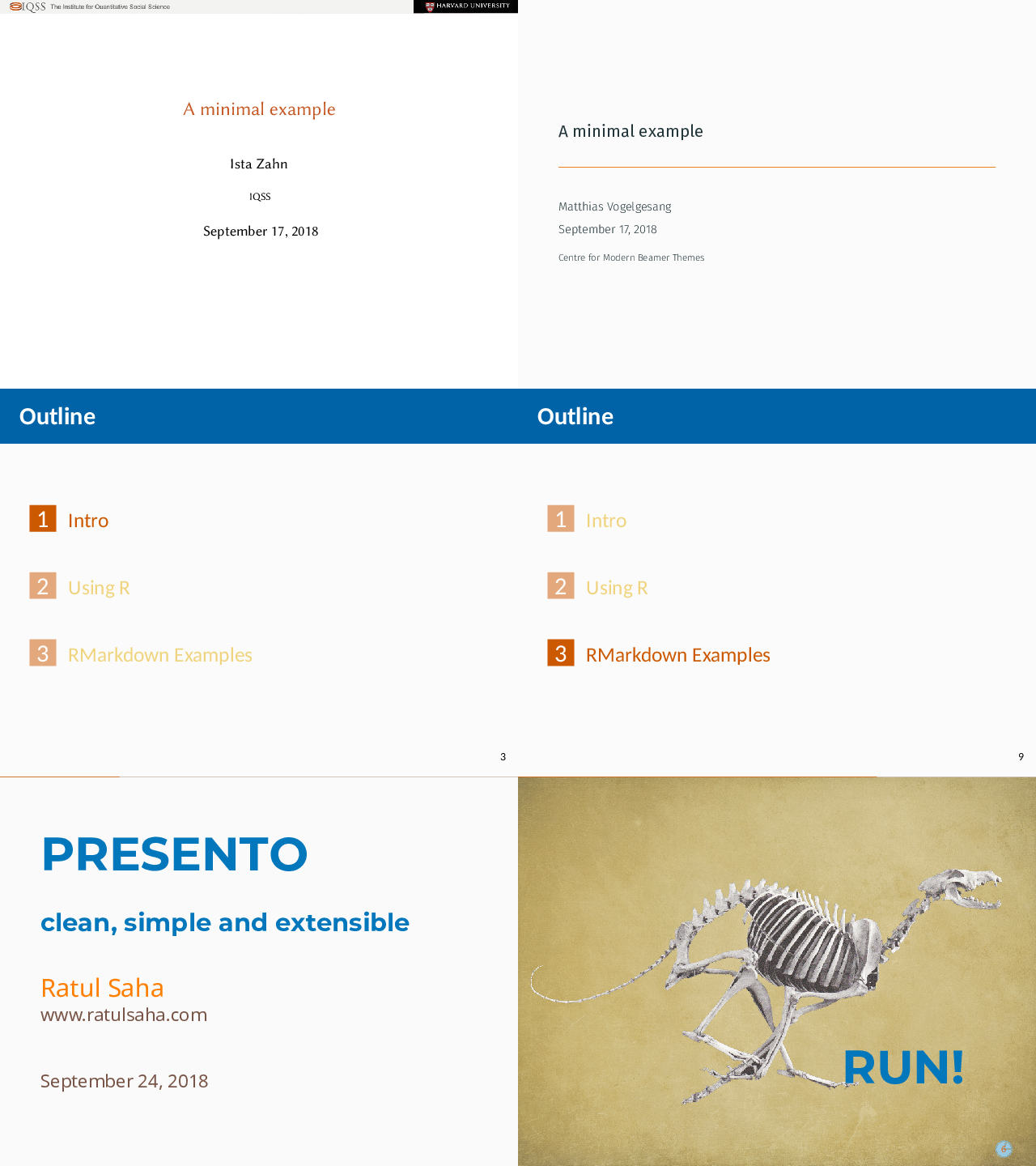
The eight release of the binb package, and first in two years, is now on CRAN and in r2u. binb regroups four rather nice themes for writing LaTeX Beamer presentations much more easily in (R)Markdown. As a teaser, a quick demo combining all four themes is available; documentation and examples are in the package.

This release contains regular internal updates to continuous integration, URLs reference and switch to Authors@R. The trigger for the release, though, was a small updated need when very recent pandoc versions (as shipped with RStudio) are used which require a new variable declaration in the LaTeX template files in order to process uncaptioned tables. The summary of changes follows.

Changes in binb version 0.0.8 (2026-05-01)

  • Small updates to documentation URLs and continuous integration

  • The package now uses Authors@R in DESCRIPTION

  • Newer pandoc versions are accommodated by adding a required counter variable in the latex template file

CRANberries provides a summary of changes to the previous version. For questions or comments, please use the issue tracker at the GitHub repo.

This post by Dirk Eddelbuettel originated on his Thinking inside the box blog. If you like this or other open-source work I do, you can sponsor me at GitHub. You can also sponsor my Tour de Shore 2026 ride in support of the Maywood Fine Arts Center.

/code/binb | permanent link

Sun, 26 Apr 2026

RProtoBuf 0.4.27 on CRAN: Upstream Adjustment

A new maintenance release 0.4.27 of RProtoBuf arrived on CRAN today. RProtoBuf provides R with bindings for the Google Protocol Buffers (“ProtoBuf”) data encoding and serialization library used and released by Google, and deployed very widely in numerous projects as a language and operating-system agnostic protocol. The new release is also already as a binary via r2u.

This release adjusts to a change upstream. Luca Billi noticed that upstream removed some fields from FieldDescriptor, filed and issue and followed up with a spotless PR. No other changes.

The following section from the NEWS.Rd file has all details and links.

Changes in RProtoBuf version 0.4.27 (2026-04-26)

  • Adjust to FieldDescriptor API changes in ProtoBuf 3.4 (Luca Billi in #114 fixing #113)

Thanks to my CRANberries, there is a diff to the previous release. The RProtoBuf page has copies of the (older) package vignette, the ‘quick’ overview vignette, and the pre-print of our JSS paper. Questions, comments etc should go to the GitHub issue tracker off the GitHub repo.

This post by Dirk Eddelbuettel originated on his Thinking inside the box blog. If you like this or other open-source work I do, you can sponsor me at GitHub. You can also sponsor my Tour de Shore 2026 ride in support of the Maywood Fine Arts Center.

/code/rprotobuf | permanent link

Thu, 23 Apr 2026

dtts 0.1.4 on CRAN: Maintenance

Leonardo and I are happy to announce another maintenance release 0.1.4 of our dtts package which has been on CRAN for four years now. dtts builds upon our nanotime package as well as the beloved data.table to bring high-performance and high-resolution indexing at the nanosecond level to data frames. dtts aims to offers the time-series indexing versatility of xts (and zoo) to the immense power of data.table while supporting highest nanosecond resolution.

This release, not unlike yesterday’s release of nanotime, is driven by recent changes in the bit64 package which underlies it. Michael, who now maintains it, had sent in two PRs to prepare for these changes. I updated continuous integration, and switched to Authors@R, and that pretty much is the release. The short list of changes follows.

Changes in version 0.1.4 (2026-04-23)

  • Continuous integration has received some routine updates

  • Adapt align() column names with changes in 'data.table' (Michael Chirico in #20)

  • Narrow imports to functions used for packages 'bit64', 'data.table' and 'nanotime' (Michael Chirico in #21)

Courtesy of my CRANberries, there is also a [diffstat repor]tbsdiffstat for this release. Questions, comments, issue tickets can be brought to the GitHub repo.

This post by Dirk Eddelbuettel originated on his Thinking inside the box blog. If you like this or other open-source work I do, you can now sponsor me at GitHub. You can also sponsor my Tour de Shore 2026 ride in support of the Maywood Fine Arts Center.

/code/dtts | permanent link

Wed, 22 Apr 2026

nanotime 0.3.14 on CRAN: Upstream Maintenance

Another minor update 0.3.14 for our nanotime package is now on CRAN, and has compiled for r2u (and will have to wait to be uploaded to Debian until dependency bit64 has been updated there). nanotime relies on the RcppCCTZ package (as well as the RcppDate package for additional C++ operations) and offers efficient high(er) resolution time parsing and formatting up to nanosecond resolution, using the bit64 package for the actual integer64 arithmetic. Initially implemented using the S3 system, it has benefitted greatly from a rigorous refactoring by Leonardo who not only rejigged nanotime internals in S4 but also added new S4 types for periods, intervals and durations.

This release has been driven almost entirely by Michael, who took over as bit64 maintainer and has been making changes there that have an effect on us ‘downstream’. He reached out with a number of PRs which (following occassional refinement and smoothing) have all been integrated. There are no user-facing changes, or behavioural changes or enhancements, in this release.

The NEWS snippet below has the fuller details.

Changes in version 0.3.14 (2026-04-22)

  • Tests were refactored to use NA_integer64_ (Michael Chirico in #149 and Dirk in #156)

  • nanoduration was updated for changes in nanotime 4.8.0 (Michael Chirico in #152 fixing #151)

  • Use of as.integer64(keep.names=TRUE) has been refactored (Michael Chirico in #154 fixing #153)

  • In tests, nanotime is attached after bit64; this still needs a better fix (Michael Chirico in #155)

  • The package now has a hard dependency on the just released bit64 version 4.8.0 (or later)

Thanks to my CRANberries, there is a diffstat report for this release. More details and examples are at the nanotime page; code, issue tickets etc at the GitHub repository – and all documentation is provided at the nanotime documentation site.

This post by Dirk Eddelbuettel originated on his Thinking inside the box blog. If you like this or other open-source work I do, you can now sponsor me at GitHub. You can also sponsor my Tour de Shore 2026 ride in support of the Maywood Fine Arts Center.

/code/nanotime | permanent link

Tue, 21 Apr 2026

RcppArmadillo 15.2.6-1 on CRAN: Several Updates

armadillo image

Armadillo is a powerful and expressive C++ template library for linear algebra and scientific computing. It aims towards a good balance between speed and ease of use, has a syntax deliberately close to Matlab, and is useful for algorithm development directly in C++, or quick conversion of research code into production environments. RcppArmadillo integrates this library with the R environment and language–and is widely used by (currently) 1263 other packages on CRAN, downloaded 45.7 million times (per the partial logs from the cloud mirrors of CRAN), and the CSDA paper (preprint / vignette) by Conrad and myself has been cited 683 times according to Google Scholar.

This versions updates to the 15.2.5 and 15.2.6 upstream Armadillo releases from, respectively, two and five days ago. The package has already been updated for Debian, and built for r2u. When we ran the reverse-dependency check for 15.2.5 at the end of last week, one package failed. I got in touch with the authors, filed an issue, poked some more, isolated the one line that caused an example to fail … and right then 15.2.6 came out fixing just that. It was after all an upstream issue. We used to ran these checks before Conrad made a release, he now skips this and hence needed a quick follow-up release. It can happen.

The other big change is that this R package release phases out the ‘dual support’ for both C++14 or newer (as in current Armadillo) along with a C++11 fallback for more slowly updating packages. I am happy to say that after over eight months of this managed transition (during which CRAN expulsed some laggard packages that were not moving in from C++11) we are now at all packages using C++14 or newer which is nice. And I will take this as an opportunity to stress that one can in fact manage a disruptive API change this way as we just demonstrated. Sadly, R Core does not seem to have gotten that message and rollout of this package was also still a little delayed because of the commotion created by the last minute API changes preceding the R 4.6.0 release later this week.

Smaller changes in the package are a switch in pdf vignette production to the Rcpp::asis() driver, and a higher-precision computation in rmultinom() (matching a change made in R-devel during last week in its use of Kahan summation). All detailed changes since the last CRAN release follow.

Changes in RcppArmadillo version 15.2.6-1 (2026-04-20)

  • Upgraded to Armadillo release 15.2.6 (Medium Roast Deluxe)

    • Ensure internally computed tolerances are not NaN
  • The rmultinom deploys 'Kahan summation' as R-devel does now.

Changes in RcppArmadillo version 15.2.5-1 [github-only] (2026-04-18)

  • Upgraded to Armadillo release 15.2.5 (Medium Roast Deluxe)

    • Fix for handling NaN elements in .is_zero()

    • Fix for handling NaN in tolerance and conformance checks

    • Faster handling of diagonal views and submatrices with one row>

  • Sunset the C++11 fallback of including Armadillo 14.6.3 (#504 closing #503)

  • The vignettes have refreshed bibliographies, and are now built using the Rcpp::asis vignette builder (#506)

  • One rmultinom test is skipped under R-devel which has switched to a higher precisions calc

Courtesy of my CRANberries, there is a diffstat report relative to previous release. More detailed information is on the RcppArmadillo page. Questions, comments etc should go to the rcpp-devel mailing list off the Rcpp R-Forge page.

This post by Dirk Eddelbuettel originated on his Thinking inside the box blog. If you like this or other open-source work I do, you can sponsor me at GitHub. You can also sponsor my Tour de Shore 2026 ride in support of the Maywood Fine Arts Center.

/code/rcpp | permanent link

Wed, 15 Apr 2026

qlcal 0.1.1 on CRAN: Calendar Updates

The nineteenth release of the qlcal package arrivied at CRAN just now, and has already been built for r2u. This version synchronises with QuantLib 1.42 released this week.

qlcal delivers the calendaring parts of QuantLib. It is provided (for the R package) as a set of included files, so the package is self-contained and does not depend on an external QuantLib library (which can be demanding to build). qlcal covers over sixty country / market calendars and can compute holiday lists, its complement (i.e. business day lists) and much more. Examples are in the README at the repository, the package page, and course at the CRAN package page.

This releases updates to the 2025 holidays for China, Singapore, and Taiwan.

The full details from NEWS.Rd follow.

Changes in version 0.1.1 (2026-04-15)

  • Synchronized with QuantLib 1.42 released two days ago

  • Calendar updates for China, Singapore, Taiwan

Courtesy of my CRANberries, there is a diffstat report for this release. See the project page and package documentation for more details, and more examples.

This post by Dirk Eddelbuettel originated on his Thinking inside the box blog. If you like this or other open-source work I do, you can sponsor me at GitHub. You can also sponsor my Tour de Shore 2026 ride in support of the Maywood Fine Arts Center.

/code/qlcal | permanent link

Tue, 14 Apr 2026

anytime 0.3.13 on CRAN: Mostly Minor Bugfix

A maintenance release 0.3.13 of the anytime package arrived on CRAN today, sticking with the roughly yearly schedule we have now. Binaries for r2u have been built already. The package is fairly feature-complete, and code and functionality remain mature and stable.

anytime is a very focused package aiming to do just one thing really well: to convert anything in integer, numeric, character, factor, ordered, … input format to either POSIXct (when called as anytime) or Date objects (when called as anydate) – and to do so without requiring a format string as well as accomodating different formats in one input vector. See the anytime page, the GitHub repo for a few examples, the nice pdf vignette, and the beautiful documentation site for all documentation.

This release was triggered by a bizarre bug seen on elementary os 8. For “reason” anytime was taking note on startup where it runs, and used a small and simply piece of code reading /etc/os-release when it exists. We assumed sane content, but this particular operating system and releases managed to have a duplicate entry throwing us spanner. So now this code is robust to duplicates, and no longer executed on each startup but “as needed” which is a net improvement. We also switched the vignette to being deployed by the new Rcpp::asis() driver.

The short list of changes follows.

Changes in anytime version 0.3.13 (2026-04-14)

  • Continuous integration has received minor updates

  • The vignette now use the Rcpp::asis() driver, and references have been refreshed

  • Stateful 'where are we running' detection is now more robust, and has been moved from running on each startup to a cached 'as needed' case

Courtesy of my CRANberries, there is also a diffstat report of changes relative to the previous release. The issue tracker tracker off the GitHub repo can be use for questions and comments. More information about the package is at the package page, the GitHub repo, in the vignette, and at the documentation site.

This post by Dirk Eddelbuettel originated on his Thinking inside the box blog. If you like this or other open-source work I do, you can now sponsor me at GitHub. You can also sponsor my Tour de Shore 2026 ride in support of the Maywood Fine Arts Center.

/code/anytime | permanent link

Sun, 12 Apr 2026

littler 0.3.23 on CRAN: Mostly Internal Fixes

max-heap image

The twentyfourth release of littler as a CRAN package landed on CRAN just now, following in the now twenty-one year history (!!) as a (initially non-CRAN) package started by Jeff in 2006, and joined by me a few weeks later.

littler is the first command-line interface for R as it predates Rscript. It allows for piping as well for shebang scripting via #!, uses command-line arguments more consistently and still starts faster. It also always loaded the methods package which Rscript only began to do in later years.

littler lives on Linux and Unix, has its difficulties on macOS due to some-braindeadedness there (who ever thought case-insensitive filesystems as a default were a good idea?) and simply does not exist on Windows (yet – the build system could be extended – see RInside for an existence proof, and volunteers are welcome!). See the FAQ vignette on how to add it to your PATH. A few examples are highlighted at the Github repo:, as well as in the examples vignette.

This release, which comes just two months after the previous 0.3.22 release that brought a few new features, is mostly internal. (The previous release erroneously had 0.3.23 in its blog and social media posts, it really was 0.3.22 and this one now is is 0.3.23.) Mattias Ellert address a nag (when building for a distribution) about one example file with a shebang not have excutable modes. I accommodated the ever-changing interface the C API of R (within about twelve hours of being notified). A few other smaller changes were made as well polishing a script or two or usual, see below for more.

The full change description follows.

Changes in littler version 0.3.23 (2026-04-12)

  • Changes in examples scripts

    • Correct spelling in installGithub.r to lower-case h

    • The r2u.r now recognises ‘resolute’ aka 26.06

    • installRub.r can install (more easily) from r-multiverse

    • A file permission was corrected (Mattias Ellert in #131)

  • Changes in package

    • Update script count and examples in README.md

    • Continuous intgegration scripts received minor updates

    • The C level access to the R API was updated to reflect most recent standards (Dirk in #132)

My CRANberries service provides a comparison to the previous release. Full details for the littler release are provided as usual at the ChangeLog page, and also on the package docs website. The code is available via the GitHub repo, from tarballs and now of course also from its CRAN page and via install.packages("littler"). Binary packages are available directly in Debian as well as (in a day or two) Ubuntu binaries at CRAN thanks to the tireless Michael Rutter. Comments and suggestions are welcome at the GitHub repo.

This post by Dirk Eddelbuettel originated on his Thinking inside the box blog. If you like this or other open-source work I do, you can sponsor me at GitHub. You can also sponsor my Tour de Shore 2026 ride in support of the Maywood Fine Arts Center.

/code/littler | permanent link

Fri, 20 Mar 2026

RcppSpdlog 0.0.28 on CRAN: Micro-Maintenance

Version 0.0.28 of RcppSpdlog arrived on CRAN today, has been uploaded to Debian and built for r2u. The (nice) documentation site has been refreshed too. RcppSpdlog bundles spdlog, a wonderful header-only C++ logging library with all the bells and whistles you would want that was written by Gabi Melman, and also includes fmt by Victor Zverovich. You can learn more at the nice package documention site.

This release contains a rebuild RcppExports.cpp to aid Rcpp in the transition towards Rcpp::stop() and away from Rf_error() in its user packages. No othe

The NEWS entry for this release follows.

Changes in RcppSpdlog version 0.0.28 (2026-03-19)

  • Regenerate RcppExports.cpp to switch to (Rf_error) aiding in Rcpp transition to Rcpp::stop()

Courtesy of my CRANberries, there is also a diffstat report detailing changes. More detailed information is on the RcppSpdlog page, or the package documention site.

This post by Dirk Eddelbuettel originated on his Thinking inside the box blog. If you like this or other open-source work I do, you can sponsor me at GitHub.

/code/rcpp | permanent link

Wed, 18 Mar 2026

tidyCpp 0.0.11 on CRAN: Microfix

And yet another maintenance release of the tidyCpp package arrived on CRAN this morning, just days after previous release which itself came a mere week and a half after its predecessor. It has been built for r2u as well. The package offers a clean C++ layer (as well as one small C++ helper class) on top of the C API for R which aims to make use of this robust (if awkward) C API a little easier and more consistent. See the vignette for motivating examples.

This release restores the small CSS file used by the vignette which we, in a last-second decision, omitted from the previous release. Oddly, it only failed under the ‘oldrel’ i.e. the R from now nearly two years ago. But it was still an unenforced error, and this upload corrects it.

Changes are summarized in the NEWS entry that follows.

Changes in tidyCpp version 0.0.11 (2026-03-17)

  • Keep a CSS file in the package to allow vignette build on r-oldrel too

Thanks to my CRANberries, there is also a diffstat report for this release. For questions, suggestions, or issues please use the issue tracker at the GitHub repo.

This post by Dirk Eddelbuettel originated on his Thinking inside the box blog. If you like this or other open-source work I do, you can now sponsor me at GitHub.

/code/tidycpp | permanent link

Tue, 17 Mar 2026

RcppArmadillo 15.2.4-1 on CRAN: Upstream Update

armadillo image

Armadillo is a powerful and expressive C++ template library for linear algebra and scientific computing. It aims towards a good balance between speed and ease of use, has a syntax deliberately close to Matlab, and is useful for algorithm development directly in C++, or quick conversion of research code into production environments. RcppArmadillo integrates this library with the R environment and language–and is widely used by (currently) 1235 other packages on CRAN, downloaded 44.9 million times (per the partial logs from the cloud mirrors of CRAN), and the CSDA paper (preprint / vignette) by Conrad and myself has been cited 672 times according to Google Scholar.

This versions updates to the 15.2.4 upstream Armadillo release from yesterday. The package has already been updated for Debian, and for r2u. This release, which we as usual checked against the reverse-dependencies, brings minor changes over the RcppArmadillo release 15.2.3 made in December (and described here) by addressing some corner-case ASAN/UBSAN reports (which Conrad, true to his style of course labels as ‘false positive’ just how he initially responded that he would ‘never’ add a fix based on such a false report; as always it is best to just watch what does as he is rather good at it, and, written comments notwithstanding, quite responsive) as well as speed-ups for empty sparse matrices. I made one more follow-up refinement on the OpenMP setup which should now ‘just work’ on all suitable platforms.

The detailed changes since the last release follow.

Changes in RcppArmadillo version 15.2.4-1 (2026-03-17)

  • Upgraded to Armadillo release 15.2.4 (Medium Roast Deluxe)

    • Workarounds for bugs in GCC and Clang sanitisers (ASAN false positives)

    • Faster handling of blank sparse matrices

  • Refined OpenMP setup (Dirk in #500)

Courtesy of my CRANberries, there is a diffstat report relative to previous release. More detailed information is on the RcppArmadillo page. Questions, comments etc should go to the rcpp-devel mailing list off the Rcpp R-Forge page.

This post by Dirk Eddelbuettel originated on his Thinking inside the box blog. If you like this or other open-source work I do, you can sponsor me at GitHub.

/code/rcpp | permanent link

Mon, 16 Mar 2026

RcppClassicExamples 0.1.4 on CRAN: Maintenance

Another minor maintenance release version 0.1.4 of package RcppClassicExamples arrived earlier today on CRAN, and has been built for r2u. This package illustrates usage of the old and otherwise deprecated initial Rcpp API which no new projects should use as the normal and current Rcpp API is so much better.

This release, the first in two and half years, mostly aids Rcpp in moving from Rf_error() to Rcpp::stop() for better behaviour under error conditions or excections. A few other things were updated in the interim such as standard upgrade to continuous integration, use of Authors@R, and switch to static linking and an improved build to support multiple macOS architectures.

No new code or features. Full details below. And as a reminder, don’t use the old RcppClassic – use Rcpp instead.

Changes in version 0.1.4 (2026-03-16)

  • Continuous integration has been updated several times

  • DESCRIPTION now uses Authors@R

  • Static linking is enforced, RcppClassic (>= 0.9.14) required

  • Calls to Rf_error() have been replaced with Rcpp::stop()

  • Updated versioned dependencies

Thanks to CRANberries, you can also look at a diff to the previous release.

This post by Dirk Eddelbuettel originated on his Thinking inside the box blog. If you like this or other open-source work I do, you can now sponsor me at GitHub.

/code/rcpp | permanent link

Sun, 15 Mar 2026

RcppClassic 0.9.14 on CRAN: Minor Update

A maintenance release 0.9.14 of the RcppClassic package arrived earlier today on CRAN, and has been built for r2u. This package provides a maintained version of the otherwise deprecated initial Rcpp API which no new projects should use as the normal and current Rcpp API is so much better.

A few changes had cumulated up since the last release in late 2022. We updated continuous integration scripts a few times, switched to Authors@R in DESCRIPTION, and rejigged build scripts a little to accommodate both possible build architectures for macOS. We also updated the vignette by updating all reference and switching the new asis vignette builder now available in Rcpp.

CRANberries also reports the changes relative to the previous release from 3 1/2 years ago. Questions, comments etc should go to the rcpp-devel mailing list off the R-Forge page.

This post by Dirk Eddelbuettel originated on his Thinking inside the box blog. If you like this or other open-source work I do, you can now sponsor me at GitHub.

/code/rcpp | permanent link

tidyCpp 0.0.10 on CRAN: Even More Maintenance

Yet another maintenance release of the tidyCpp package arrived on CRAN this morning, a mere week and a half after the previous release. It has been built for r2u as well. The package offers a clean C++ layer (as well as one small C++ helper class) on top of the C API for R which aims to make use of this robust (if awkward) C API a little easier and more consistent. See the vignette for motivating examples.

This release, just like the preceding one less than two weeks ago, had its hand forced by an overnight change in R-devel. The breakage this created has since been reverted in R-devel but as the writing is on the wall are now removing the definition involving these accessors preemptively. We were also missing version checks for two newly added alternates.

Changes are summarized in the NEWS entry that follows.

Changes in tidyCpp version 0.0.10 (2026-03-15)

  • Hide five accessors as underlying macros removed from Rinternals

  • Preemptively hide another accessor

  • Ensure two definitions are conditional on R 4.5.0 or later

Thanks to my CRANberries, there is also a diffstat report for this release. For questions, suggestions, or issues please use the issue tracker at the GitHub repo.

This post by Dirk Eddelbuettel originated on his Thinking inside the box blog. If you like this or other open-source work I do, you can now sponsor me at GitHub.

/code/tidycpp | permanent link

Fri, 13 Mar 2026

RcppCNPy 0.2.15 on CRAN: Maintenance

Another maintenance release of the RcppCNPy package arrived on CRAN today, and has already been built as an r2u binary. RcppCNPy provides R with read and write access to NumPy files thanks to the cnpy library by Carl Rogers along with Rcpp for the glue to R.

The changes are minor and similar to other recent changes. We aid Rcpp in the transition away from calling Rf_error() by relying in Rcpp::stop() which has better behaviour and unwinding when errors or exceptions are encountered. So once again no user-facing changes. Full details are below.

Changes in version 0.2.15 (2026-03-13)

  • Replaced Rf_error with Rcpp::stop in three files

  • Maintenance updates to continuous integration

CRANberries also provides a diffstat report for the latest release. As always, feedback is welcome and the best place to start a discussion may be the GitHub issue tickets page.

If you like this or other open-source work I do, you can now sponsor me at GitHub.

This post by Dirk Eddelbuettel originated on his Thinking inside the box blog. Please report excessive re-aggregation in third-party for-profit settings.

/code/rcpp | permanent link

Thu, 12 Mar 2026

RcppBDT 0.2.8 on CRAN: Maintenance

Another minor maintenance release for the RcppBDT package is now on CRAN, and had been built as binary for r2u.

The RcppBDT package is an early adopter of Rcpp and was one of the first packages utilizing Boost and its Date_Time library. The now more widely-used package anytime is a direct descentant of RcppBDT.

This release is again primarily maintenance. We aid Rcpp in the transition away from calling Rf_error() by relying in Rcpp::stop() which has better behaviour and unwinding when errors or exceptions are encountered. No feature or interface changes.

The NEWS entry follows:

Changes in version 0.2.8 (2026-03-12)

  • Replaced Rf_error with Rcpp::stop in three files

  • Maintenance updates to continuous integration

Courtesy of my CRANberries, there is also a diffstat report for this release. For questions, suggestions, or issues please use the issue tracker at the GitHub repo.

This post by Dirk Eddelbuettel originated on his Thinking inside the box blog. If you like this or other open-source work I do, you can now sponsor me at GitHub.

/code/rcpp | permanent link

Wed, 11 Mar 2026

RcppDE 0.1.9 on CRAN: Maintenance

Another maintenance release of our RcppDE package arrived at CRAN, and has been built for r2u. RcppDE is a “port” of DEoptim, a package for derivative-free optimisation using differential evolution, from plain C to C++. By using RcppArmadillo the code became a lot shorter and more legible. Our other main contribution is to leverage some of the excellence we get for free from using Rcpp, in particular the ability to optimise user-supplied compiled objective functions which can make things a lot faster than repeatedly evaluating interpreted objective functions as DEoptim does (and which, in fairness, most other optimisers do too). The gains can be quite substantial.

This release is again maintenance. We aid Rcpp in the transition away from calling Rf_error() by relying in Rcpp::stop() which has better behaviour and unwinding when errors or exceptions are encountered. We also overhauled the references in the vignette, added an Armadillo version getter and made the regular updates to continuous integration.

Courtesy of my CRANberries, there is also a diffstat report. More detailed information is on the RcppDE page, or the repository.

This post by Dirk Eddelbuettel originated on his Thinking inside the box blog. If you like this or other open-source work I do, you can sponsor me at GitHub.

/code/rcpp | permanent link

Mon, 09 Mar 2026

nanotime 0.3.13 on CRAN: Maintenance

Another minor update 0.3.13 for our nanotime package is now on CRAN, and has been uploaded to Debian and compiled for r2u. nanotime relies on the RcppCCTZ package (as well as the RcppDate package for additional C++ operations) and offers efficient high(er) resolution time parsing and formatting up to nanosecond resolution, using the bit64 package for the actual integer64 arithmetic. Initially implemented using the S3 system, it has benefitted greatly from a rigorous refactoring by Leonardo who not only rejigged nanotime internals in S4 but also added new S4 types for periods, intervals and durations.

This release, the first in eleven months, rounds out a few internal corners and helps Rcpp with the transition away from Rf_error to only using Rcpp::stop which deals more gracefully with error conditions and unwinding. We also updated how the vignette is made, its references, updated the continuous integration as one does, altered how the documentation site is built, gladly took a PR from Michael polishing another small aspect, and tweaked how the compilation standard is set.

The NEWS snippet below has the fuller details.

Changes in version 0.3.13 (2026-03-08)

  • The methods package is now a Depends as WRE recommends (Michael Chirico in #141 based on a suggestion by Dirk in #140)

  • The mkdocs-material documentation site is now generated via altdoc

  • Continuous Integration scripts have been updated

  • Replace Rf_error with Rcpp::stop, turn remaining one into (Rf_error) (Dirk in #143)

  • Vignette now uses the Rcpp::asis builder for pre-made pdfs (Dirk in #146 fixing #144)

  • The C++ compilation standard is explicitly set to C++17 if an R version older than 4.3.0 is used (Dirk in #148 fixing #147)

  • The vignette references have been updated

Thanks to my CRANberries, there is a diffstat report for this release. More details and examples are at the nanotime page; code, issue tickets etc at the GitHub repository – and all documentation is provided at the nanotime documentation site.

This post by Dirk Eddelbuettel originated on his Thinking inside the box blog. If you like this or other open-source work I do, you can now sponsor me at GitHub.

/code/nanotime | permanent link

Sat, 07 Mar 2026

RProtoBuf 0.4.26 on CRAN: More Maintenance

A new maintenance release 0.4.26 of RProtoBuf arrived on CRAN today. RProtoBuf provides R with bindings for the Google Protocol Buffers (“ProtoBuf”) data encoding and serialization library used and released by Google, and deployed very widely in numerous projects as a language and operating-system agnostic protocol. The new release is also already as a binary via r2u.

This release brings an update to aid in an ongoing Rcpp transitions from Rf_error to Rcpp::stop, and includes a few more minor cleanups including one contributed by Michael.

The following section from the NEWS.Rd file has full details.

Changes in RProtoBuf version 0.4.26 (2026-03-06)

  • Minor cleanup in DESCRIPTION depends and imports

  • Remove obsolete check for utils::.DollarNames (Michael Chirico in #111)

  • Replace Rf_error with Rcpp::stop, turn remaining one into (Rf_error) (Dirk in #112)

  • Update configure test to check for RProtoBuf 3.3.0 or later

Thanks to my CRANberries, there is a diff to the previous release. The RProtoBuf page has copies of the (older) package vignette, the ‘quick’ overview vignette, and the pre-print of our JSS paper. Questions, comments etc should go to the GitHub issue tracker off the GitHub repo.

This post by Dirk Eddelbuettel originated on his Thinking inside the box blog. If you like this or other open-source work I do, you can sponsor me at GitHub.

/code/rprotobuf | permanent link

Thu, 05 Mar 2026

RcppGSL 0.3.14 on CRAN: Maintenance

A new release 0.3.14 of RcppGSL is now on CRAN. The RcppGSL package provides an interface from R to the GNU GSL by relying on the Rcpp package. It has already been uploaded to Debian, and is also already available as a binary via r2u.

This release, the first in over three years, contains mostly maintenance changes. We polished the fastLm example implementation a little more, updated continunous integration as one does over such a long period, adopted the Authors@R convention, switched the (pre-made) pdf vignette to a new driver now provided by Rcpp, updated vignette references and URLs, and updated one call to Rf_error to aid in a Rcpp transition towards using only Rcpp::stop which unwinds error conditions better. (Technically this was a false positive on Rf_error but on the margin worth tickling this release after all this time.)

The NEWS entry follows:

Changes in version 0.3.14 (2026-03-05)

  • Updated some internals of fastLm example, and regenerated RcppExports.* files

  • Several updates for continuous integration

  • Switched to using Authors@R

  • Replace ::Rf_error with (Rf_error) in old example to aid Rcpp transition to Rcpp::stop (or this pass-through)

  • Vignette now uses the Rcpp::asis builder for pre-made pdfs

  • Vignette references have been updated, URLs prefer https and DOIs

Thanks to my CRANberries, there is also a diffstat report for this release. More information is on the RcppGSL page. Questions, comments etc should go to the issue tickets at the GitHub repo.

This post by Dirk Eddelbuettel originated on his Thinking inside the box blog. If you like this or other open-source work I do, you can now sponsor me at GitHub.

/code/rcpp | permanent link

Wed, 04 Mar 2026

tidyCpp 0.0.9 on CRAN: More (forced) Maintenance

Another maintenance release of the tidyCpp package arrived on CRAN this morning. The packages offers a clean C++ layer (as well as one small C++ helper class) on top of the C API for R which aims to make use of this robust (if awkward) C API a little easier and more consistent. See the vignette for motivating examples.

This release follows a similar release in November and had its hand forced by rather abrupt and forced overnight changes in R-devel, this time the removal of VECTOR_PTR in [this commit]. The release also contains changes accumulated since the last release (including some kindly contritbuted by Ivan) and those are signs that the R Core team can do more coordinated release management when they try a little harder.

Changes are summarize in the NEWS entry that follows.

Changes in tidyCpp version 0.0.9 (2026-03-03)

  • Several vignette typos have been corrected (#4 addressing #3)

  • A badge for r-universe has been added to the README.md

  • The vignette is now served via GitHub Pages and that version is referenced in the README.

  • Two entry points reintroduced and redefined using permitted R API function (Ivan Krylov in #5).

  • Another entry has been removed to match R-devel API changes.

  • Six new attributes helpers have been added for R 4.6.0 or later.

  • VECTOR_PTR_RO(x) replaces the removed VECTOR_PTR, a warning or deprecation period would have been nice here.

Thanks to my CRANberries, there is also a diffstat report for this release. For questions, suggestions, or issues please use the issue tracker at the GitHub repo.

This post by Dirk Eddelbuettel originated on his Thinking inside the box blog. If you like this or other open-source work I do, you can now sponsor me at GitHub.

/code/tidycpp | permanent link

Fri, 27 Feb 2026

x13binary 1.1.61.2 on CRAN: Micro Maintenance

The x13binary team is happy to share the availability of Release 1.1.61.2 of the x13binary package providing the X-13ARIMA-SEATS program by the US Census Bureau which arrived on CRAN earlier today, and has already been built for r2u.

This release responds to a CRAN request to display the compiler version when building. x13binary, just like three other packages there, creates and ships a local binary it interfaces with. So our build was a little outside of R CMD INSTALL ... but now signals build versions like R does. We also modernized and simplified our continuous intgegration script based on r-ci.

Courtesy of my CRANberries, there is also a diffstat report for this release showing changes to the previous release.

This post by Dirk Eddelbuettel originated on his Thinking inside the box blog. If you like this or other open-source work I do, you can sponsor me at GitHub.

/code/x13binary | permanent link

Wed, 18 Feb 2026

qlcal 0.1.0 on CRAN: Easier Calendar Switching

The eighteenth release of the qlcal package arrivied at CRAN today. There has been no calendar update in QuantLib 1.41 so it has been relatively quiet since the last release last summer but we now added a nice new feature (more below) leading to a new minor release version.

qlcal delivers the calendaring parts of QuantLib. It is provided (for the R package) as a set of included files, so the package is self-contained and does not depend on an external QuantLib library (which can be demanding to build). qlcal covers over sixty country / market calendars and can compute holiday lists, its complement (i.e. business day lists) and much more. Examples are in the README at the repository, the package page, and course at the CRAN package page.

This releases makes it (much) easier to work with multiple calendars. The previous setup remains: the package keeps one ‘global’ (and hidden) calendar object which can be set, queried, altered, etc. But now we added the ability to hold instantiated calendar objects in R. These are external pointer objects, and we can pass them to functions requiring a calendar. If no such optional argument is given, we fall back to the global default as before. Similarly for functions operating on one or more dates, we now simply default to the current date if none is given. That means we can now say

> sapply(c("UnitedStates/NYSE", "Canada/TSX", "Australia/ASX"), 
         \(x) qlcal::isBusinessDay(xp=qlcal::getCalendar(x)))
UnitedStates/NYSE        Canada/TSX     Australia/ASX 
             TRUE              TRUE              TRUE 
> 

to query today (February 18) in several markets, or compare to two days ago when Canada and the US both observed a holiday

> sapply(c("UnitedStates/NYSE", "Canada/TSX", "Australia/ASX"),
         \(x) qlcal::isBusinessDay(as.Date("2026-02-16"), xp=qlcal::getCalendar(x)))
UnitedStates/NYSE        Canada/TSX     Australia/ASX 
            FALSE             FALSE              TRUE 
> 

The full details from NEWS.Rd follow.

Changes in version 0.1.0 (2026-02-18)

  • Invalid calendars return id ‘TARGET’ now

  • Calendar object can be created on the fly and passed to the date-calculating functions; if missing global one used

  • For several functions a missing date object now implies computation on the current date, e.g. isBusinessDay()

Courtesy of my CRANberries, there is a diffstat report for this release. See the project page and package documentation for more details, and more examples.

This post by Dirk Eddelbuettel originated on his Thinking inside the box blog. If you like this or other open-source work I do, you can sponsor me at GitHub.

Edited 2026-02-21 to correct a minor earlier error: it referenced a QuantLib 1.42 release which does not (yet) exist.

/code/qlcal | permanent link

Thu, 12 Feb 2026

RcppSpdlog 0.0.27 on CRAN: C++20 Accommodations

Version 0.0.27 of RcppSpdlog arrived on CRAN moments ago, and will be uploaded to Debian and built for r2u shortly. The (nice) documentation site will be refreshed too. RcppSpdlog bundles spdlog, a wonderful header-only C++ logging library with all the bells and whistles you would want that was written by Gabi Melman, and also includes fmt by Victor Zverovich. You can learn more at the nice package documention site.

Brian Ripley has now turned C++20 on as a default for R-devel (aka R 4.6.0 ‘to be’), and this turned up misbehvior in packages using RcppSpdlog such as our spdl wrapper (offering a nicer interface from both R and C++) when relying on std::format. So for now, we turned this off and remain with fmt::format from the fmt library while we investigate further.

The NEWS entry for this release follows.

Changes in RcppSpdlog version 0.0.27 (2026-02-11)

  • Under C++20 or later, keep relying on fmt::format until issues experienced using std::format can be identified and resolved

Courtesy of my CRANberries, there is also a diffstat report detailing changes. More detailed information is on the RcppSpdlog page, or the package documention site.

This post by Dirk Eddelbuettel originated on his Thinking inside the box blog. If you like this or other open-source work I do, you can sponsor me at GitHub.

/code/rcpp | permanent link